


Charter Flights

Available Fleet

Blog
Contacts


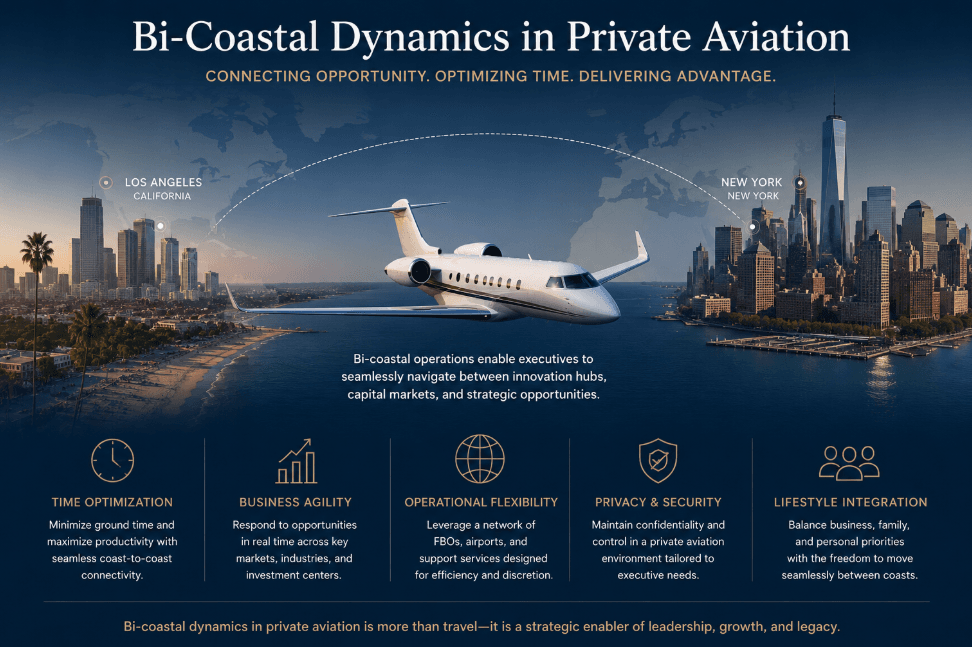
The aviation corridor connecting New York and Los Angeles represents one of the most strategically important domestic mobility networks in the United States. More than a transportation route, it serves as a high-frequency economic artery linking the country’s two most influential ecosystems: finance, media, entertainment, technology, fashion, and cultural production.
Unlike conventional city-pair aviation markets driven primarily by tourism or regional commerce, the New York–Los Angeles corridor reflects a deeper structural relationship between two complementary centers of global influence. New York serves as a hub of international finance, corporate law, investment management, and media ownership, while Los Angeles is a global center for entertainment production, digital content, luxury branding, and creative industries.
Private aviation plays a particularly important role in this corridor because many executives, investors, creators, athletes, legal advisors, and high-profile public figures require mobility systems that support compressed schedules, confidentiality, and uninterrupted operational continuity.
As economic integration between financial capital and cultural production intensifies, the bi-coastal aviation network continues evolving into one of the most dynamic executive mobility systems in North America.
Financial Capital and Creative Capital
New York and Los Angeles represent two distinct yet highly interconnected forms of economic power.
New York specializes in:
Los Angeles dominates sectors involving:
Modern business increasingly requires continuous interaction between these sectors, creating sustained demand for rapid bi-coastal mobility.
The Rise of Hybrid Executive Roles
Many professionals now operate simultaneously across both ecosystems.
Examples include:
These overlapping economic structures have intensified demand for flexible and efficient private aviation systems.
Time as Strategic Infrastructure
Executives operating between New York and Los Angeles frequently maintain highly compressed schedules involving:
Within this environment, travel efficiency directly affects productivity and economic performance.
Private aviation minimizes delays associated with:
This allows travelers to preserve greater operational control.
Cross-Time-Zone Coordination
The three-hour time difference between the East and West Coasts creates additional scheduling complexity.
Executives often coordinate activity involving:
Private aviation provides greater flexibility for managing these overlapping operational windows.
Teterboro and Van Nuys as Strategic Anchors
The bi-coastal aviation corridor is heavily supported by executive airports specifically optimized for private aviation operations.
On the East Coast, Teterboro Airport provides:
On the West Coast, Van Nuys Airport supports:
Together, these airports function as strategic anchors within the national executive mobility network.
The Importance of Secondary Airports
Secondary airports play a critical role because they provide:
For high-frequency travelers, these operational advantages significantly improve mobility efficiency.
Executive Confidentiality in High-Profile Industries
Both New York and Los Angeles contain industries where confidentiality and controlled visibility are operationally important.
Private aviation supports discretion for:
Dedicated terminals and restricted-access environments reduce exposure to:
Mobility as Reputation Management
In industries heavily influenced by public perception and market sensitivity, transportation itself becomes part of broader strategic image management.
Private aviation provides:
These characteristics are particularly valuable within celebrity-driven and finance-driven ecosystems.
Multi-Residence Living Patterns
Many bi-coastal travelers maintain residences in both New York and Los Angeles.
This reflects broader trends involving:
Private aviation supports these distributed lifestyles by reducing the friction associated with long-distance domestic travel.
Continuity Between Work and Lifestyle
The New York–Los Angeles corridor increasingly supports a blended ecosystem where professional activity and lifestyle management overlap continuously.
Travelers frequently coordinate:
Private aviation allows these systems to function with greater continuity and flexibility.
The Importance of Long-Range Domestic Capability
The approximately 2,500-mile distance between New York and Los Angeles requires an aircraft capable of balancing:
Aircraft serving this corridor often prioritize:
These features support productivity during transcontinental operations.
Fleet Flexibility and Scheduling Adaptation
Operators serving the corridor must also manage fluctuating demand linked to:
Fleet adaptability, therefore, becomes central to operational efficiency.
AI-Assisted Scheduling Coordination
Artificial intelligence increasingly supports executive mobility planning by analyzing:
These systems improve operational responsiveness within highly compressed executive environments.
Digital Continuity Across Coasts
Integrated digital platforms increasingly allow passengers to maintain seamless coordination between:
This continuity reduces cognitive disruption and improves executive productivity during frequent travel.
Environmental Scrutiny of Executive Mobility
As private aviation expands, high-frequency domestic routes such as New York–Los Angeles are attracting greater environmental scrutiny.
Public scrutiny often focuses on:
Corporate ESG expectations are also influencing how organizations evaluate aviation partnerships.
Smarter Operational Efficiency
Operators increasingly respond through:
These measures aim to balance executive mobility needs with evolving sustainability priorities.
The Corridor as a Symbol of Influence
The New York–Los Angeles aviation corridor carries symbolic importance beyond transportation alone.
It represents the integration of:
Few domestic aviation routes combine such concentrated economic and cultural power.
Mobility as National Connectivity
The corridor also reflects broader shifts in how modern American economic systems function, moving toward continuous national and global coordination rather than isolated regional activity.
Private aviation increasingly supports this interconnected structure by enabling faster and more adaptable movement between strategic centers of influence.
Increasing Demand for Flexible Mobility
As business ecosystems become more decentralized and globally integrated, demand for bi-coastal executive aviation is expected to remain strong.
Future growth will likely be influenced by:
Aviation as Strategic Infrastructure
The New York–Los Angeles corridor increasingly demonstrates how private aviation functions not merely as transportation, but as strategic infrastructure supporting national economic coordination, executive efficiency, and high-value professional mobility.
In the coming decade, operators capable of combining flexibility, sustainability, technological intelligence, and operational precision will likely define the future of bi-coastal aviation leadership.