


Charter Flights

Available Fleet

Blog
Contacts


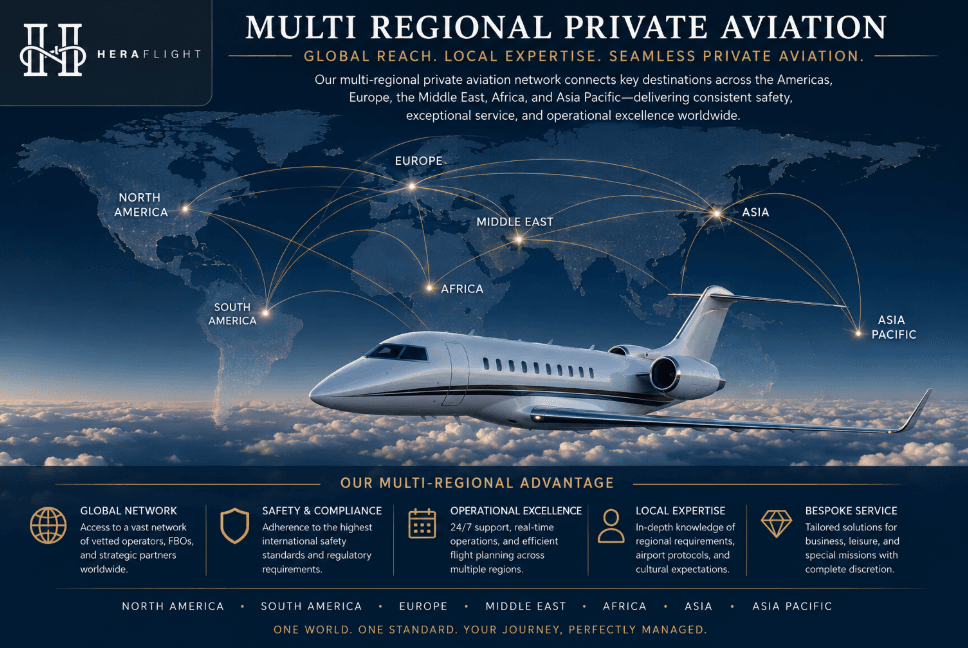
Fleet strategy has become one of the most critical operational foundations within modern private aviation. As international mobility networks grow increasingly interconnected, operators must balance aircraft performance, operational efficiency, regional accessibility, passenger expectations, and long-range capability across highly diverse global environments.
Unlike localized aviation systems, multi-regional and intercontinental operations require fleets capable of adapting to different airport infrastructures, regulatory systems, climate conditions, passenger profiles, and mission requirements. Aircraft must perform efficiently across short regional sectors, high-density financial corridors, seasonal luxury destinations, and ultra-long-range international routes.
Modern private aviation operators increasingly rely on diversified fleet structures designed to maximize flexibility while minimizing operational inefficiency. Aircraft selection now influences not only route capability, but also scheduling resilience, maintenance planning, fuel optimization, airport accessibility, and long-term asset value.
Companies such as Hera Flight Aircraft Sales reflect the growing industry emphasis on aligning aircraft acquisition and fleet development strategies with evolving global mobility demands and operational complexity.
Understanding Multi-Regional Aviation Networks
Multi-regional aviation refers to operations spanning several geographic markets with varying infrastructure characteristics and operational requirements.
These may include:
Operators serving multiple regions must maintain aircraft capable of adapting to different runway lengths, weather systems, regulatory environments, and passenger expectations.
Fleet flexibility, therefore, becomes essential to maintaining operational continuity across geographically diverse markets.
The Importance of Fleet Diversification
A diversified fleet enables operators to better match aircraft capabilities with mission-specific requirements.
Typical fleet structures may include:
This layered strategy improves:
Diversification also reduces operational risk by preventing excessive dependence on a single aircraft category.
The Demands of Intercontinental Travel
Long-haul private aviation operations are significantly more complex than regional flight environments.
Intercontinental missions require aircraft capable of managing:
Routes connecting North America, Europe, the Middle East, and Asia frequently require advanced long-range operational capability.
Aircraft operating within these environments must balance performance, efficiency, cabin comfort, and operational reliability simultaneously.
Large-Cabin and Ultra-Long-Range Jets
Long-haul operations typically depend on large-cabin, ultra-long-range aircraft.
These aircraft provide:
Aircraft categories commonly used within intercontinental operations include:
These fleets support nonstop connectivity between major international business and luxury markets.
Regional Infrastructure Differences
Fleet planning must account for substantial differences in airport infrastructure across international markets.
For example:
Operators must therefore align aircraft selection with the operational realities of each target market.
Seasonal Demand Variation
Seasonality also strongly influences fleet deployment strategies.
Luxury destinations such as:
experience concentrated periods of elevated demand requiring temporary fleet repositioning and capacity adjustments.
Operators serving these markets must maintain sufficient flexibility to respond rapidly to changing traffic concentration patterns.
Maximizing Fleet Productivity
Fleet strategy is closely tied to aircraft utilization efficiency.
Operators seek to minimize:
while maximizing productive flight hours and scheduling flexibility.
Efficient fleet management directly affects profitability within private aviation.
Balancing Ownership and Charter Economics
Aircraft acquisition decisions increasingly involve careful analysis of:
Modern fleet planning, therefore, requires simultaneous operational and financial optimization.
Access to Secondary Airports
One of private aviation’s major advantages is access to smaller executive airports unavailable to many commercial aircraft.
Fleet selection directly influences this flexibility.
Aircraft optimized for secondary airport access may provide:
Smaller and midsize jets often retain advantages in dense metropolitan areas where executive airports face operational limitations.
Long-Range Aircraft and Global Reach
At the same time, long-range aircraft provide strategic access to international destinations without requiring intermediate stops.
This capability improves:
Nonstop long-haul capability has become increasingly important within global executive mobility systems.
Predictive Fleet Analytics
Artificial intelligence and predictive analytics increasingly influence fleet management decisions.
Operators now analyze:
These systems improve long-term fleet optimization and operational responsiveness.
Real-Time Operational Coordination
Modern fleet management platforms support:
This technological integration improves operational resilience across multi-regional aviation networks.
Strategic Aircraft Acquisition
Aircraft acquisition is one of the most significant financial decisions within private aviation.
Operators must evaluate:
A poorly aligned acquisition strategy may create substantial long-term operational inefficiencies.
The Importance of Advisory Expertise
Because aircraft transactions involve significant technical and financial complexity, operators increasingly rely upon specialized advisory services during acquisition and resale processes.
Modern aviation advisory systems often include:
Providers such as Hera Flight Aircraft Sales emphasize strategic aircraft acquisition and fleet alignment based on travel patterns, operational requirements, and long-term ownership objectives.
Environmental Pressure on Aviation Fleets
Environmental expectations increasingly influence aircraft acquisition and fleet modernization decisions.
Operators now prioritize:
These considerations are becoming central to long-term fleet planning.
New Generation Aircraft Technology
Modern aircraft increasingly incorporate:
These innovations improve both operational economics and environmental performance.
Greater Demand for Operational Flexibility
Future aviation networks will likely require even greater flexibility as global mobility patterns continue evolving.
Operators must increasingly adapt to:
Fleet adaptability will therefore remain one of the industry’s most important strategic assets.
Integrated Global Mobility Systems
The future of fleet strategy will likely involve deeper integration between:
Aircraft fleets will increasingly function as intelligent mobility ecosystems rather than isolated transportation assets.
Fleet strategy has become a defining factor in the success of modern multi-regional and long-haul aviation operations. As private aviation networks expand across increasingly interconnected global markets, operators must balance aircraft capability, operational efficiency, passenger expectations, and long-term financial sustainability within highly dynamic environments.
Successful fleet planning now requires far more than aircraft ownership alone. It involves strategic alignment between route structure, airport accessibility, operational flexibility, technological intelligence, and evolving market demand.
Diversified fleets, predictive analytics, advanced aircraft technology, and adaptive operational systems are reshaping how private aviation supports international business, luxury mobility, and executive connectivity across global regions.
In the coming decade, the operators best positioned for long-term success will likely be those capable of combining fleet adaptability, intelligent infrastructure, and strategic acquisition planning into fully integrated global aviation ecosystems.