



Charter Flights

Empty Leg Flights
Available Fleet
Blog
Contacts


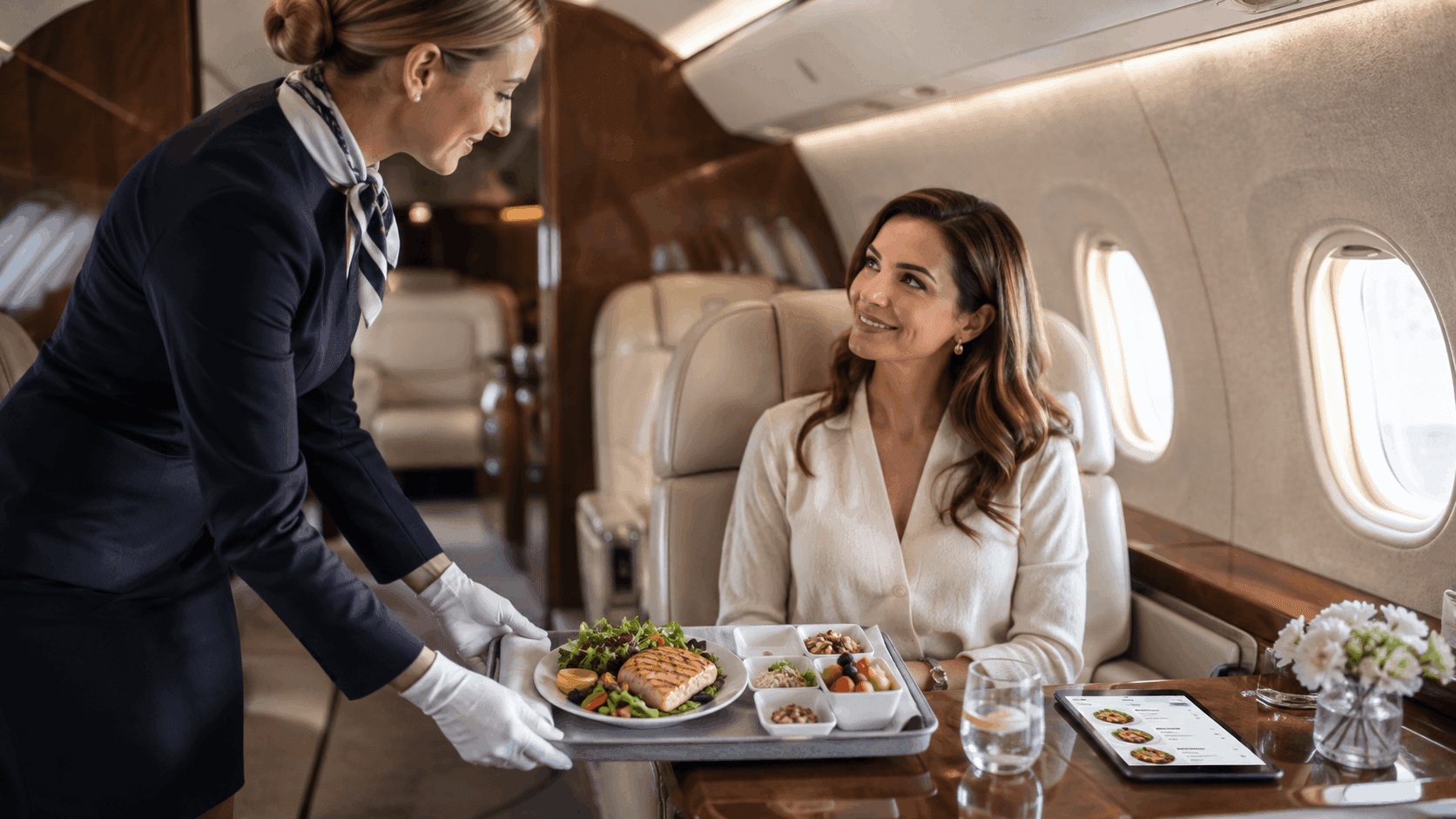
Private aviation provides considerably more control over catering than scheduled commercial travel, which can be particularly valuable for passengers with food allergies or special dietary requirements. Menus can often be planned around individual passengers, catering suppliers can receive detailed instructions before departure, and the amount and type of food brought into the cabin can be adjusted to suit the group.
That flexibility, however, should not be mistaken for a guarantee that an aircraft or catering environment can be made completely free of a particular allergen. Food may pass through commercial kitchens, catering facilities, restaurants, ground handlers, FBOs, delivery vehicles, and aircraft galleys before reaching a passenger. Each stage can introduce the possibility of allergen cross-contact.
For travelers with medically significant allergies, successful planning therefore depends on clear communication, careful food selection, appropriate emergency preparedness, and realistic expectations about what a charter operator or catering supplier can control.
Private aviation can simplify several aspects of traveling with dietary restrictions.
Instead of selecting from a predetermined airline menu, passengers can usually communicate their requirements before the catering order is placed. Depending on the airport, aircraft, and amount of notice provided, the charter team may be able to source meals from specialist caterers, restaurants, or suppliers familiar with particular dietary needs.
Passengers may also have greater control over which foods are brought aboard the aircraft.
Possible requests can include:
These options can make meal planning more predictable, but they do not remove the need for normal food-allergy precautions.
One of the most useful things passengers can do is describe their requirement precisely.
A catering request such as “no nuts” can mean several different things.
One traveler might simply dislike nuts. Another might have a diagnosed allergy requiring strict avoidance and concern about cross-contact.
Likewise, “dairy-free,” “gluten-free,” or “seafood-free” can refer to different dietary needs with different levels of required precaution.
When communicating with a charter provider, passengers should indicate whether the request involves:
The distinction helps the catering team understand whether substituting an ingredient is sufficient or whether additional questions about preparation and cross-contact need to be addressed.
U.S. food-labeling law identifies nine major food allergens:
Sesame became the ninth major allergen under federal law effective January 1, 2023. The FDA requires covered packaged foods containing major allergens to identify the allergen source in the ingredient information.
These nine foods account for many serious allergic reactions, but they are not the only foods capable of causing an allergy.
A passenger should therefore communicate the exact allergen rather than simply asking the catering team to avoid “the major allergens.”
Packaged food can sometimes offer a useful advantage for passengers with allergies because ingredient information can be reviewed before eating.
Under U.S. rules, covered packaged foods must identify major food allergens used as ingredients. The declaration may appear directly within the ingredient list or through a separate “Contains” statement.
For example, a label might state:
Contains: Milk, Wheat, Soy
Passengers should still read the complete ingredient list rather than relying solely on front-of-package claims.
FDA guidance also notes that ingredients can change, making it prudent to examine the label each time rather than assuming that a familiar product still has the same formulation.
This can make factory-sealed products useful components of an allergy-aware private jet catering plan.
A freshly prepared restaurant or aviation-catering meal should not automatically be treated like a sealed packaged product.
FDA allergen-labeling requirements cover many packaged foods, but foods prepared and placed into containers following a customer’s order may not carry the same type of standardized allergen labeling.
That means a catering box without a warning label cannot safely be assumed to contain no allergens.
For passengers with significant allergies, useful questions may include:
The answers may help the passenger decide whether the meal fits their own allergy-management plan.
Cross-contact occurs when an allergen is unintentionally introduced into a food that would not otherwise contain it.
The FDA identifies examples such as shared equipment, inadequate cleaning, improper separation of allergens, and production practices that allow allergen material to move between foods.
For private aviation, potential cross-contact points can exist throughout the catering chain.
They may include:
A meal that contains no peanut as an intentional ingredient, for example, is not necessarily equivalent to a meal prepared in a peanut-free environment.
That distinction is especially important for travelers who react to small amounts of an allergen.
Some packaged foods include advisory language such as:
The FDA explains that these types of advisory statements are voluntary rather than universally required. Their absence therefore does not automatically prove that no cross-contact risk exists.
Travelers should follow the advice they have received from their own healthcare professional regarding precautionary allergen statements.
For private jet catering, the practical lesson is that a general instruction such as “please make this meal nut-free” may not provide enough information about the preparation environment.
Advance communication is one of the most useful precautions a passenger can take.
Food Allergy Research & Education recommends giving travel organizers and food-service personnel as much notice as possible when requesting allergy accommodations.
For private aviation, early notification gives the charter team time to:
A request made during initial trip planning is easier to manage than one received shortly before departure.
Avoid broad descriptions whenever possible.
Instead of:
“Passenger has a nut allergy.”
provide the specific information given by the passenger or their healthcare professional, such as:
“Passenger is allergic to peanuts and cashews.”
Tree nuts are not a single food for labeling purposes. The FDA requires covered products to identify the particular type of tree nut involved, such as almond, pecan, or walnut.
Specificity reduces ambiguity and gives the caterer more useful information.
The catering team should also understand that an allergy request is medically significant when that is the case.
A useful instruction can distinguish between:
The charter provider may not be able to guarantee every requested condition, particularly when using independent catering suppliers.
If a supplier cannot confidently answer a critical question, passengers should use the precautions established with their healthcare professional rather than relying on assumptions.
Private jet catering can come from several sources.
Depending on the airport, food may be supplied by:
These suppliers can have different procedures for handling allergens.
For a severe allergy, knowing who prepared the meal allows the relevant questions to be directed to the actual food provider rather than relying on information passed through several intermediaries.
When practical, individually packaged meals can simplify handling.
For example, one passenger’s allergy-conscious meal may be:
This does not automatically eliminate cross-contact from the original preparation process, but it can reduce opportunities for the meal to become mixed up with another passenger’s food after delivery.
Clear labeling is particularly useful when several passengers have different dietary requirements.
Complex dishes often contain more ingredients and require more preparation steps.
For a passenger managing a serious food allergy, a simple menu may sometimes provide greater transparency.
Examples could include foods with:
The appropriate menu depends on the individual’s allergy-management requirements.
The objective is not necessarily to create the most elaborate catering order. It is to create one for which the passenger can obtain the information they need to make an informed decision.
Some passengers feel more comfortable traveling with food they already know and trust.
CDC travel guidance recommends that people with food allergies consider bringing safe snacks or meals for use during travel.
Private aviation can sometimes make personal catering easier because meals do not necessarily need to fit within a standardized airline service program.
However, passengers should discuss outside food with the charter provider before departure.
Considerations may include:
Food that can be taken aboard in one country may not necessarily be allowed to enter another country after landing.
Even when customized catering has been arranged, backup food can be useful.
Possible disruptions include:
CDC and FARE both recommend that food-allergic travelers carry safe snacks or meals rather than depending entirely on food obtained during travel.
For a long private flight, backup food should be sufficient for the practical needs of the journey rather than limited to one small snack.
Customized catering does not replace medical preparedness.
Travelers at risk for anaphylaxis should follow the emergency plan and medication instructions provided by their healthcare professional.
CDC guidance recommends that travelers at risk for anaphylaxis keep medications on their person or in immediately accessible carry-on baggage rather than placing them where they cannot be quickly reached. It also recommends reviewing the traveler’s medication regimen and anaphylaxis action plan before travel.
FARE similarly advises travelers with food allergies to keep their prescribed epinephrine accessible and to travel with their emergency care plan.
Medication should therefore not be treated like ordinary baggage that can be placed somewhere inaccessible during flight.
For travelers who have been prescribed epinephrine, the specific travel plan should be discussed with their healthcare professional.
FARE recommends carrying two epinephrine doses and keeping them accessible rather than placing them in checked baggage.
CDC also recommends ensuring that travelers have sufficient medication for their trip and know how to use their injectable epinephrine device.
Passengers should check:
The passenger’s personal clinician should remain the source of individualized medical advice.
Travelers with a history that places them at risk of anaphylaxis may also benefit from carrying their physician-provided emergency plan.
CDC recommends an updated anaphylaxis action plan as part of pre-travel preparation.
The plan can help communicate:
Travel companions should also know where medication and emergency information are kept.
FARE recommends that people traveling with an allergic passenger know where their medication is located and how to respond during an emergency.
The charter company should receive allergy information during planning, but passengers should also verify that the relevant operating crew is aware of important requirements before departure.
The purpose is not to transfer medical responsibility to the crew.
Instead, communication can help ensure that:
Private aircraft vary in staffing. A large jet may have a dedicated cabin attendant, while a smaller jet may operate without one.
Passengers should therefore understand the service arrangement before relying on cabin assistance.
Sometimes a passenger may ask that a particular food not be intentionally served onboard.
A private aircraft can offer more control over the cabin menu than a scheduled commercial service because catering is being arranged for a small, known passenger group.
For example, a charter team may be able to avoid ordering:
However, this should not be described as making the aircraft completely “allergen-free.”
Previous passengers may have brought their own food aboard, packaged products can contain unexpected ingredients, and catering may have been prepared in shared facilities.
A more accurate goal is to reduce avoidable exposure according to the passenger’s requirements without offering guarantees that cannot be verified.
Passengers with specific concerns can ask what cabin cleaning is performed before departure and whether particular surfaces can receive additional attention.
Relevant areas might include:
CDC guidance for travelers with severe allergies discusses cleaning the seating area as one possible precaution during air travel.
The appropriate measures depend on the individual’s allergy and healthcare advice.
Cleaning should not be presented as a substitute for food controls or emergency preparedness.
Peanut and tree-nut allergies are among the dietary concerns commonly communicated during travel.
Private charter can provide additional control because the onboard snack selection can potentially be changed for the specific trip.
Passengers might request:
Tree nuts should be identified specifically where possible rather than treating every tree nut as interchangeable.
Passengers should still follow their personal allergy action plan because eliminating an intentionally served food does not prove that the wider catering environment is free from cross-contact.
Milk and egg can appear in foods where their presence is not immediately obvious.
Examples may include:
For packaged products regulated by the FDA, these major allergens generally must be identified appropriately on the label.
Freshly prepared catering may require direct communication with the supplier.
A request such as “no glass of milk” is therefore different from a medically required milk-free meal.
Fish and Crustacean shellfish are also among the FDA’s major food allergens.
When a passenger has a relevant allergy, the catering plan can potentially avoid ordering seafood for that passenger or, when requested and feasible, for the broader group.
Questions about preparation areas and utensils may also be important when the same kitchen handles seafood for other meals.
For serious allergies, the required level of precaution should be discussed with the passenger’s healthcare professional and clearly communicated to catering personnel.
Sesame is now one of the nine major food allergens recognized under U.S. federal food-labeling requirements.
Sesame can appear in products including breads, sauces, seasoning mixtures, and foods prepared with tahini.
Passengers should therefore avoid assuming that only clearly visible sesame seeds are relevant.
Packaged-food labels can provide useful ingredient information, while freshly catered meals may require questions directed to the supplier.
Gluten-free catering is commonly requested in private aviation.
The phrase should nevertheless be communicated carefully because the reason for avoiding gluten can affect the passenger’s required precautions.
A traveler may want gluten-free food as a personal preference, while another may need stricter procedures because of a medical requirement.
Rather than relying on the phrase alone, passengers should explain the level of precaution they need based on guidance from their healthcare professional.
Potential menu choices may include:
Preparation practices remain relevant when avoiding cross-contact is necessary.
Vegetarian and vegan meals generally require different planning from allergen-specific catering.
A vegetarian menu may exclude meat while allowing dairy products or eggs, depending on the passenger.
A vegan menu generally excludes animal-derived foods.
Passengers should still specify their exact requirements because broad dietary labels can be interpreted differently by different kitchens.
Menu possibilities can include:
If a vegan passenger also has a food allergy, both requirements should be communicated separately.
Kosher requirements can involve ingredients, food preparation, certification, equipment, and serving practices.
At major private aviation airports, certified kosher catering may be available from specialist suppliers.
At smaller airports, additional notice may be necessary because meals may need to be transported from another facility.
Passengers who require a particular certification level should state that requirement specifically rather than simply requesting a “kosher-style” menu.
The charter team can then determine what suppliers are available at the departure point.
Halal catering can similarly require appropriate sourcing and preparation.
Availability is usually greatest at major metropolitan and international aviation hubs.
Passengers should specify whether they require formally certified halal catering and whether there are additional ingredients they avoid.
Advance notice gives the charter team more opportunity to identify an appropriate supplier rather than improvising shortly before departure.
Private aviation catering becomes more complex when one passenger has several restrictions.
For example, a meal might need to be:
Another passenger on the same aircraft may have entirely different requirements.
Individual packaging and clear labeling can help keep meals organized.
Providing written instructions is especially valuable when several dietary requirements need to be communicated through the charter provider, caterer, ground handler, and cabin crew.
When a child has a food allergy, parents or guardians should communicate the requirement during trip planning and follow the child’s existing medical emergency plan.
FARE recommends traveling with children’s prescribed allergy medication and keeping it accessible, while also ensuring that accompanying adults know how to respond to an emergency.
Families may prefer to bring familiar foods from home, particularly for younger children.
Customized private catering can also be useful because an individual child’s meal can be arranged separately from the adults’ menu.
International private travel introduces additional planning considerations.
The availability of specialist catering varies among destinations, and local food terminology may differ.
CDC recommends that travelers with food allergies consider carrying cards that list their allergies in the language of their destination.
FARE similarly recommends preparing translated chef cards and learning important allergy-related phrases for international travel.
Useful information might communicate:
Translation can reduce ambiguity when dealing with catering providers outside the passenger’s primary language.
Travelers should also consider whether their usual medications will be readily available at the destination.
CDC advises people at risk for anaphylaxis to obtain sufficient medication for the trip and notes that medicines in other countries may have different names or availability.
For international private travel, passengers may want to discuss with their healthcare professional:
Keeping prescribed medication in original packaging can also make identification easier during international travel.
International private aviation also involves customs and agricultural regulations.
Travelers may be able to bring personally prepared or packaged food aboard the aircraft but face restrictions when attempting to take leftover products into another country.
Rules can apply to products such as:
Passengers carrying their own allergy-safe food should therefore check applicable entry restrictions as part of international trip planning.
The operator or handling agent may be able to provide logistical guidance, while government authorities remain the definitive source for destination import requirements.
Operational conditions occasionally require the aircraft assigned to a charter to change.
This could happen because of:
When an allergy-sensitive catering plan has been created, dietary instructions should remain attached to the trip rather than only to the originally scheduled aircraft.
Passengers may wish to reconfirm their catering arrangements if notified of an aircraft or departure-airport change.
A departure-airport change can be particularly important.
The original airport may have access to a specialist caterer familiar with the passenger’s requirements, while an alternative airport may use a different supplier.
If a trip changes at short notice, passengers should ask whether:
This illustrates why backup planning remains valuable even in customized private aviation.
A one-hour flight and a 10-hour flight create very different food requirements.
On a short journey, a traveler may decide to eat before departure and rely primarily on safe packaged snacks.
A long-range journey may require several meals.
For long flights, planning should address:
A carefully planned menu can reduce dependence on last-minute substitutions.
The aircraft itself can influence the catering plan.
A light jet may have:
A larger business jet may provide:
For passengers with complex dietary needs, simpler food can sometimes be more practical on a smaller aircraft.
The quality of allergy planning should therefore be matched to the equipment and staffing actually available onboard.
Dietary requirements are most effectively treated as part of trip planning rather than as a last-minute catering note.
When arranging a urlprivate jet charterhttps://heraflight.com/charter, passengers with allergies or special dietary requirements should communicate their needs early enough for the charter team to coordinate aircraft catering, the supplying kitchen, airport handling, and onboard service.
A useful written request can include:
Written information reduces the possibility that important details are lost when instructions pass between multiple parties.
Passengers with food allergies may want to ask:
Not every supplier will be able to answer every question or guarantee every requested condition.
If the information available does not meet the passenger’s personal safety requirements, bringing known safe food may be a more appropriate choice.
Before a private flight, a traveler managing a food allergy can consider the following:
The appropriate precautions vary from person to person and should reflect the traveler’s medical guidance.
Often, yes. A private charter provider may be able to arrange customized catering around a specified food allergy, depending on the departure airport, supplier, aircraft, and amount of notice available.
Generally, such a guarantee should not be assumed. Previous passengers, shared catering facilities, packaged products, ground handling, and aircraft-service equipment can all create potential exposure routes. Travelers should discuss the specific precautions available rather than relying on broad “allergen-free” claims.
Yes. Early communication gives the charter team more time to discuss the requirement with caterers and ground-service providers. FARE recommends giving travel and food-service personnel as much advance notice as practical.
Often this can be arranged, although airport, operator, storage, security, and international customs requirements may apply. Travelers should confirm the plan with the charter provider before departure.
Travelers should continue following the medication and emergency plan provided by their healthcare professional. Customized catering does not eliminate the possibility of accidental exposure. CDC recommends keeping required medications immediately accessible during travel.
CDC and FARE guidance recommends keeping prescribed emergency medication accessible rather than placing it in checked baggage.
Travelers should follow their clinician’s individualized medical advice. FARE recommends that people who have been prescribed epinephrine travel with two doses available.
Packaging can make ingredient information easier to review, but no food should automatically be considered safe for a particular individual. In the United States, covered packaged foods must identify major allergens used as ingredients, while voluntary “may contain” statements are not universally required.
They are milk, eggs, fish, Crustacean shellfish, tree nuts, peanuts, wheat, soybeans, and sesame.
Cross-contact is the unintended introduction of an allergen into another food. It can occur through shared equipment, preparation surfaces, inadequate cleaning, or other food-production practices.
A charter provider may be able to avoid intentionally loading certain foods for a particular trip, but that should not be interpreted as proof that the aircraft or catering environment contains no traces of the allergen.
Gluten-free catering is commonly possible, but passengers should clearly explain whether the request is a preference or involves a medical requirement so the catering team understands the necessary level of precaution.
They often can, especially from major private aviation airports. Certified meals may require specialist suppliers and advance notice.
Travelers should follow the precautions established with their healthcare professional and avoid relying on uncertain information. FDA consumer guidance advises people with food allergies to avoid a food when they cannot determine whether it contains an ingredient to which they are allergic.
Communicate requirements before departure, carry required medications and an emergency plan, consider safe backup food, and prepare translated information describing the allergy. CDC recommends translated allergy cards and maintaining accessible emergency medication during international travel.
Private aviation can give travelers with food allergies and special dietary requirements significantly greater control over what is ordered and served during a journey. Individualized catering, direct communication, separately packaged meals, and the ability to bring familiar foods can all make planning easier.
The most important advantage, however, is not the promise of a perfectly controlled environment. It is the opportunity to plan in detail. Communicating the exact allergy, asking appropriate questions about preparation and cross-contact, carrying suitable backup food, and maintaining the traveler’s normal medical preparedness creates a more robust approach than relying on a menu label alone.
For passengers with serious food allergies, catering arrangements should complement—not replace—the individualized emergency and avoidance plan established with their healthcare professional.