



Charter Flights

Empty Leg Flights
Available Fleet
Blog
Contacts


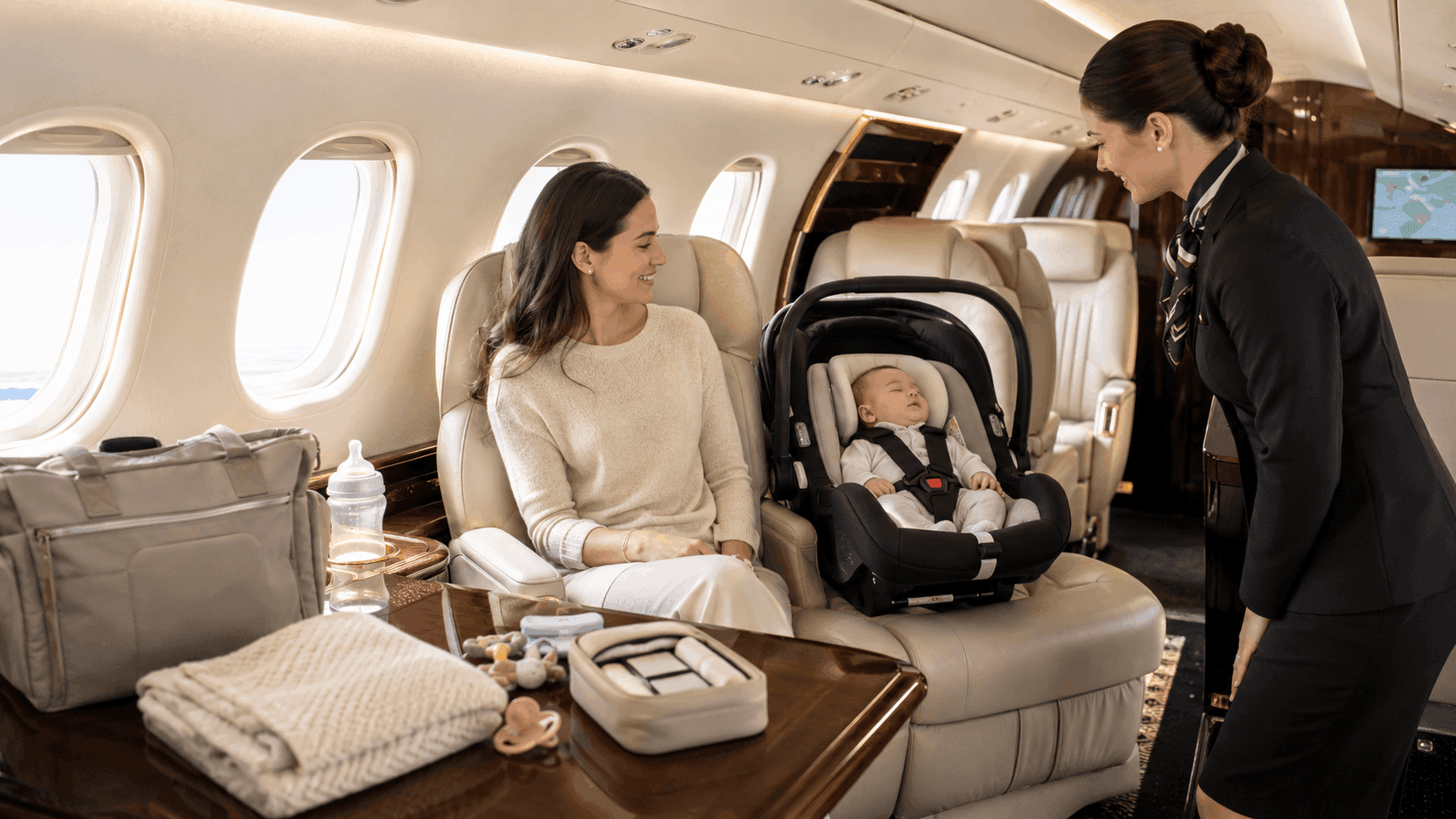
Flying Private With Infants: Car Seats, Cabin Safety, and Essential Preparation
Private aviation can make family travel with an infant significantly easier by reducing time in crowded terminals, allowing more flexible scheduling, and giving families greater control over the travel environment.
That flexibility, however, does not eliminate the need for careful preparation.
Traveling with an infant involves questions about seating, child restraint systems, cabin safety, feeding, diaper changes, baggage, strollers, sleep routines, ground transportation, and international documentation. The smallest aircraft with enough passenger seats is not always the most practical choice when a family is also carrying a car seat, stroller, diaper bag, extra clothing, feeding supplies, and other infant equipment.
The best approach is to treat the infant's requirements as part of the mission from the beginning.
Private aviation can reduce several of the most difficult parts of traveling with a baby.
Instead of moving through a large commercial terminal, families may use a private terminal or FBO with a quieter environment and shorter walking distances.
Potential advantages include:
For parents trying to work around feeding, naps, and changing schedules, these differences can make the overall journey more manageable.
The key is planning the aircraft and itinerary around the family's actual needs.
There is no single answer that applies to every flight.
The appropriate seating arrangement can depend on:
Some operations may permit an infant to be held by an adult under certain conditions, while others may recommend or require a separate seat and approved restraint.
Parents should confirm the arrangement before booking rather than assuming private aviation operates under a completely different safety framework.
A properly installed and approved child restraint can provide additional protection during:
Even on a smooth flight, turbulence can occur without much warning.
A child restraint system helps keep the infant secured rather than relying entirely on an adult's ability to hold the child during sudden movement.
The exact restraint used should be appropriate for the child's size and compatible with the aircraft seat.
A child restraint system is a seat or device designed to secure a child during transportation.
For aviation use, parents may encounter:
Not every car seat is automatically suitable for aircraft use.
The restraint should have appropriate certification or labeling for use on aircraft where required.
The operator should also confirm that the specific aircraft seat can accommodate it.
Before the trip, parents should inspect the restraint and review its manufacturer documentation.
Useful checks include:
This is especially important on smaller private jets where seat dimensions can be narrower or configured differently from commercial aircraft.
A child seat that fits comfortably in a family vehicle may be too wide for a particular aircraft seat.
Important measurements can include:
Private jet cabins vary considerably.
A light jet may have limited seat width and aisle space, while a larger cabin aircraft may provide substantially more room.
Providing exact dimensions before aircraft selection helps avoid surprises on departure day.
The correct orientation depends on several factors.
These can include:
Parents should follow the child-seat manufacturer's instructions and the operator's guidance.
An aircraft cabin should not be used as a place to improvise a restraint installation.
Aircraft selection should consider much more than passenger count.
Families may want to evaluate:
A jet that technically seats four passengers may still be inconvenient for two parents, an infant, a nanny, a stroller, a car seat, and several bags.
A slightly larger aircraft can sometimes create a significantly better family travel experience.
When arranging family travel through Hera Flight, parents can discuss passenger count, car-seat requirements, stroller dimensions, baggage, preferred departure time, and destination ground transportation before the aircraft is selected.
This kind of advance planning helps the flight team understand the complete mission rather than treating infant equipment as an afterthought.
For families, that can reduce the chance of baggage limitations, unsuitable seating, or last-minute ground transportation problems.
Private cabins can feel relaxed and informal, but normal aviation safety principles still apply.
Parents should follow crew instructions regarding:
Loose items should be secured.
Diaper bags, bottles, toys, and other infant supplies should not block aisles or exits.
Essential items can remain accessible while still being stored safely.
Turbulence is one of the strongest reasons to think carefully about infant restraint.
Most turbulence is not dangerous, but unexpected movement can cause unsecured passengers or objects to move suddenly.
Parents should respond immediately when the crew asks passengers to sit down or secure items.
A private aircraft does not remove the physical forces associated with turbulence.
Before taxi, families should have the cabin organized.
A useful routine includes:
Trying to reorganize the cabin after the aircraft begins taxiing can create unnecessary stress.
Before descent and landing, parents should again secure the infant and cabin.
Loose blankets, bottles, toys, and bags should be stored.
If the infant is using a restraint system, it should be installed and used according to the required procedure.
The crew may provide additional instructions based on the aircraft and flight conditions.
Parents should bring enough feeding supplies for the planned flight and reasonable delays.
Possible items include:
Private jets may have galleys, but capabilities vary significantly by aircraft.
A small jet may have limited facilities, while a large-cabin aircraft may offer more extensive galley equipment.
Families should confirm warming and storage options in advance if these are important.
Pre-measured formula can simplify travel.
Parents may want to bring:
Do not rely on the aircraft having exactly the same kitchen capability as a home environment.
The crew can explain what is available onboard.
Weather, ground delays, or diversions can extend total travel time.
Parents should avoid packing only the exact amount of formula or food required for the published flight time.
A reasonable reserve can prevent an ordinary delay from becoming a difficult situation.
Pressure changes during climb and descent can cause temporary discomfort for infants.
Some parents find that feeding, nursing, or offering a pacifier during these phases can help because swallowing may assist with pressure equalization.
Individual medical concerns should be discussed with a pediatric professional.
Parents should not rely on general travel advice for a baby with a known ear, respiratory, or other medical condition.
Private jets are pressurized, but cabin pressure is generally equivalent to being at a moderate altitude rather than sea level.
Healthy infants commonly travel by air, but certain medical situations may require individualized guidance.
Parents of infants who were premature, recently ill, or who have respiratory or cardiac concerns should speak with their healthcare professional before travel.
Very young infants require additional consideration.
Factors may include:
There is no universal age at which every infant is automatically ready for air travel.
Medical questions should be addressed with the child's healthcare professional.
Operational questions should be addressed with the charter provider.
Lavatories vary dramatically across private aircraft.
A larger jet may have a spacious enclosed lavatory.
A smaller aircraft may have a much more compact facility.
Parents should ask about:
A portable changing mat can be useful.
Families should not assume every aircraft has a commercial-airliner-style baby changing table.
A dedicated infant bag should include the items that may be needed during the flight.
Useful items can include:
These items should remain accessible.
Do not place essential medication or all feeding supplies in an external compartment that cannot be reached in flight.
A two-hour flight does not necessarily mean the family needs exactly two hours of supplies.
Total travel can be extended by:
Extra diapers, food, and clothing provide useful flexibility.
Strollers are common but can create baggage problems.
The operator should know:
Compact travel strollers are generally easier to accommodate than full-size systems.
A stroller that seems small when unfolded around the home can still be bulky when packed with a car-seat base and family luggage.
At many private aviation facilities, it may be possible to keep the stroller until close to boarding.
The exact procedure depends on:
This can make private aviation particularly convenient for families with small children.
The stroller can then be placed into the baggage compartment shortly before departure.
Portable bassinets may be useful at the destination, but they should not automatically be treated as approved inflight restraints.
If parents intend to use a bassinet inside the aircraft cabin, they should discuss the plan with the operator before departure.
Otherwise, it may simply travel as baggage.
Infant travel systems can include:
Together, these components can occupy substantial baggage volume.
When the family is also carrying several suitcases, the storage requirement can become one of the main factors influencing aircraft selection.
Families with infants often carry much more baggage than adult business travelers.
Typical items include:
Aircraft selection should therefore be based on the complete baggage profile, not just the number of passengers.
A detachable car seat base can be surprisingly bulky.
Parents should specify whether they are bringing:
This helps planners understand how much physical baggage space is required.
The infant's transportation requirements continue after the aircraft lands.
Families may need:
Ground transportation should be arranged before departure.
It is inefficient to land at the destination and discover that the waiting vehicle cannot safely accommodate the infant or family luggage.
Advantages can include:
The disadvantage is additional baggage.
Families may need to carry both the seat and its base.
Some chauffeur or transportation providers may be able to provide child restraints.
This can reduce the amount of equipment the family carries.
Parents should still confirm:
Do not assume every ground transportation provider automatically carries an appropriate infant seat.
One of the useful features of private aviation is greater flexibility around family routines.
Parents may choose a departure that aligns with:
This can make the flight easier for both the infant and adults.
However, departure time is still influenced by aircraft availability, weather, crew scheduling, airport operating hours, and other operational factors.
Families often benefit from avoiding multiple connections.
A nonstop private flight can reduce:
This can be especially valuable for infants who respond poorly to repeated changes in environment.
Private aviation may provide access to airports closer to the family's destination.
Reducing the ground journey after landing can be valuable when traveling with a baby.
A 20-minute drive can be considerably easier than a 90-minute transfer after a long flight.
Airport choice should therefore be evaluated as part of the complete family journey.
Noise levels vary by aircraft type and seating position.
Some parents may choose suitable hearing protection for an infant, particularly on noisier aircraft.
Any product should be appropriate for the child's age and used correctly.
If parents have medical concerns related to infant hearing, they should consult a healthcare professional.
Aircraft cabins can occasionally be warmer or cooler during ground operations.
Parents can prepare with layered clothing.
Useful items may include:
The crew can generally adjust the cabin environment once aircraft systems are fully operating.
Cabin shades can help reduce:
This can create a better environment for naps.
Shade design varies between aircraft.
Some have manual shades, while others have electronic systems.
Infant entertainment should be simple and easy to secure.
Useful choices include:
Avoid bringing many small loose objects that can roll around the cabin.
For older infants, downloaded media can also be useful.
Essential medication should remain in accessible hand luggage.
Parents should consider carrying:
If medication requires refrigeration or other special conditions, tell the operator before the flight.
Some infants travel with specialized medical equipment.
The operator should be informed early if the child requires:
Relevant details can include:
Operator approval or additional planning may be necessary.
International flights add border and document requirements.
Families may need:
The exact requirements depend on nationality and destination.
For international air travel, infants generally need appropriate travel documents just like older passengers.
Parents should check the current requirements for:
Do not assume that a birth certificate alone will be sufficient for international air travel.
When only one parent travels internationally with a child, some destinations may request additional documentation.
Possible examples include:
Requirements vary.
Families should confirm destination-specific rules before departure.
A nanny or caregiver counts as an additional passenger.
This affects:
If the caregiver is traveling internationally, passport and visa requirements also apply.
Private terminals can create a calmer environment for families.
Potential benefits include:
This can be particularly valuable with an infant who needs feeding or changing shortly before departure.
Private aviation generally requires less airport time than scheduled airline travel.
However, families should allow enough time for:
A family carrying substantial infant equipment may need a little more preparation time than two adult passengers traveling with small bags.
Private aircraft can occasionally be substituted because of maintenance, weather, or scheduling.
For families, the replacement aircraft should still meet infant-related requirements.
Confirm that it remains suitable for:
An aircraft with the same number of passenger seats may have a very different cabin layout.
Advance notice allows the operator to plan properly.
Useful information includes:
The earlier these details are provided, the easier it is to choose the correct aircraft.
Several issues are easy to avoid.
Common mistakes include:
Good preparation prevents most of these problems.
Before departure, families can review:
Generally yes, subject to the operator's policies, applicable regulations, aircraft configuration, and any individual medical considerations.
It depends on the operation, age, applicable rules, and operator policy. Parents should confirm the seating arrangement before booking.
Often yes, provided the restraint is appropriate for aircraft use and compatible with the specific aircraft seat. Give the operator the exact model in advance.
Usually yes, but the folded dimensions and available baggage space should be confirmed before departure.
Yes when conditions permit, although lavatory size and changing-space availability vary considerably by aircraft.
Yes. Families should bring enough feeding supplies for the planned journey plus reasonable reserves for delays.
Infants generally need appropriate international travel documentation. Requirements depend on nationality, destination, and itinerary.
Availability varies. Parents should ask in advance rather than assuming an aircraft-appropriate child restraint will be provided.
Provide the infant's age, passenger count, car-seat model, stroller dimensions, baggage requirements, medical equipment, and relevant international document needs.
Private aviation can make flying with an infant more manageable by reducing terminal time, offering greater privacy, allowing more convenient airport choices, and giving families more control over departure schedules.
The key advantage is flexibility, but that flexibility works best when the infant's needs are incorporated into planning before the aircraft is selected.
Parents should confirm the seating arrangement and child restraint requirements, provide car-seat and stroller dimensions, and make sure the aircraft offers enough baggage capacity for the complete family load.
Essential food, medication, diapers, and clothing should remain accessible during flight. Ground transportation should be arranged with an appropriate infant restraint, and international journeys require the same careful passport and entry-document planning as other forms of air travel.
The best family private-flight experience is therefore not simply about choosing a comfortable jet.
It is about coordinating aircraft configuration, cabin safety, baggage, feeding, scheduling, and ground transportation around the infant's real needs from departure to final destination.