


Charter Flights

Available Fleet

Blog
Contacts


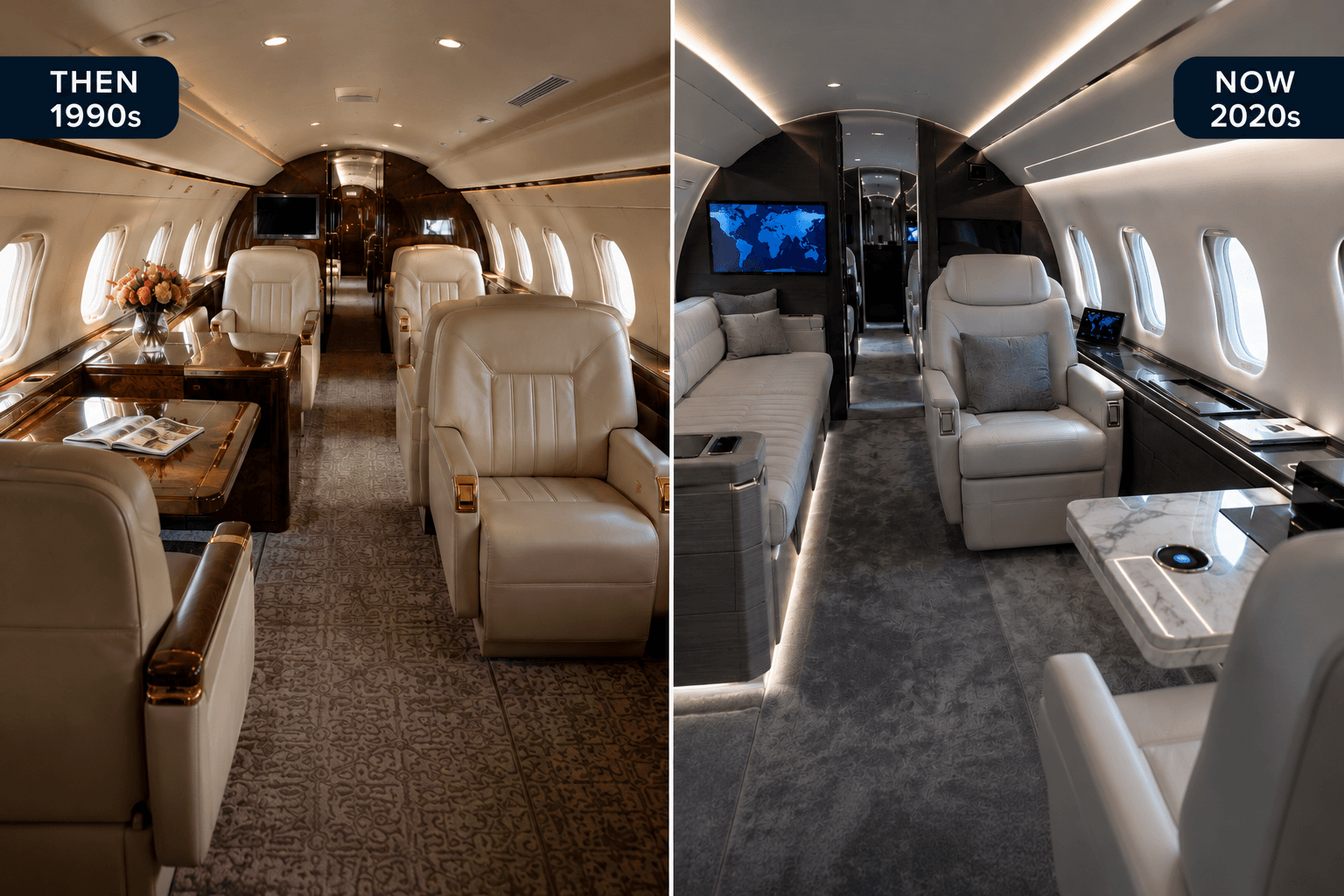
Luxury has always been a defining characteristic of business aviation. From its earliest days, private air travel offered a level of exclusivity, comfort, and convenience that distinguished it from commercial transportation. However, the meaning of luxury within the aviation industry has undergone a profound transformation over the past several decades. What was once defined primarily by spacious cabins, premium materials, and personalized service has evolved into a far more sophisticated concept centered on efficiency, customization, privacy, wellness, and technological integration.
Today, luxury in business aviation is no longer measured solely by visible displays of opulence. Instead, it reflects a broader commitment to delivering highly personalized travel experiences that maximize time, productivity, comfort, and flexibility. This evolution mirrors changing expectations among modern travelers, who increasingly value experiences and outcomes over traditional status symbols.
As private aviation continues to adapt to shifting consumer preferences and technological advancements, understanding the evolution of luxury provides valuable insights into the industry's future direction.
The emergence of business aviation during the mid-twentieth century introduced a new approach to air travel. Early corporate aircraft provided executives with a means of traveling more efficiently than commercial airline schedules would allow.
During this period, luxury was primarily associated with exclusivity and convenience. Business aircraft offered:
Compared with the era's commercial air travel, these features represented a significant advancement in both practicality and prestige.
As aircraft technology improved, manufacturers began introducing larger cabins, more refined interiors, and increased passenger amenities, reinforcing the association between private aviation and luxury.
Throughout the 1980s and 1990s, luxury in business aviation became increasingly associated with physical comfort and visible indicators of wealth.
Aircraft interiors featured:
The aircraft cabin became a symbol of professional success and personal achievement.
Manufacturers competed to create increasingly sophisticated interiors, while operators focused on delivering premium service experiences. During this era, luxury was largely defined by what passengers could see, touch, and experience during the flight itself.
Although these elements remain important today, they no longer represent the primary drivers of perceived value among many private aviation clients.
The twenty-first century has witnessed a significant shift in consumer attitudes toward luxury.
Across numerous industries, affluent consumers increasingly prioritize experiences over possessions. Business aviation has followed a similar trajectory.
Modern travelers are less concerned with demonstrating status and more focused on optimizing their lifestyles, protecting their time, and minimizing inconvenience.
As a result, luxury has become increasingly linked to:
The ability to depart on demand, avoid crowded terminals, and travel directly to destinations has become more valuable than many traditional luxury amenities.
In this context, the greatest luxury is often the elimination of friction.
Perhaps no factor has become more important in contemporary business aviation than time.
For executives, entrepreneurs, investors, and family office principals, time represents a finite and highly valuable resource. Commercial travel frequently imposes significant inefficiencies through:
Business aviation addresses these challenges by placing travelers in control of their schedules.
Private terminals, expedited boarding procedures, direct routing, and access to thousands of airports worldwide enable travelers to reclaim valuable hours that would otherwise be lost.
Consequently, modern luxury is increasingly defined not by extravagance but by efficiency.
Today's private aviation clients expect experiences tailored specifically to their preferences.
Personalization extends far beyond traditional customer service and encompasses virtually every aspect of the travel experience.
Examples include:
Rather than adapting to a standardized travel product, passengers increasingly expect the travel experience to adapt to them.
This level of customization has become one of the defining features of luxury in modern business aviation.
As public visibility and digital connectivity continue to expand, privacy has emerged as a critical component of luxury.
For corporate executives, investors, public figures, and high-net-worth individuals, confidentiality often represents a strategic necessity.
Private aviation offers significant privacy advantages through:
Passengers can conduct sensitive discussions, review confidential materials, and travel without public exposure.
In many cases, privacy itself has become one of the most valuable luxury benefits private aviation can provide.
Technology has fundamentally transformed modern business aviation.
Historically, luxury cabins emphasized comfort and aesthetics. Today, connectivity and digital functionality play equally important roles.
Modern business aircraft frequently incorporate:
For many travelers, uninterrupted connectivity is no longer a convenience but an operational requirement.
The ability to remain productive while crossing continents has become an essential aspect of luxury travel.
One of the most significant developments in recent years has been the integration of wellness-focused design principles into aircraft cabins.
Research increasingly demonstrates that long-distance travel can affect:
Aircraft manufacturers have responded by introducing features specifically designed to improve passenger health.
Lower Cabin Altitudes
Advanced pressurization systems reduce physiological stress during flight.
Improved Air Quality
Modern filtration systems continuously refresh cabin air and improve passenger comfort.
Enhanced Humidity Control
Higher humidity levels help mitigate dehydration and fatigue during long journeys.
Circadian Lighting Systems
Adaptive lighting technologies support natural sleep cycles and assist with jet lag management.
Luxury is no longer measured solely by comfort during the journey but also by passenger condition upon arrival.
The concept of luxury is increasingly influenced by environmental considerations.
Modern travelers are becoming more conscious of sustainability and expect premium service providers to demonstrate environmental responsibility.
Within business aviation, this has led to increased focus on:
Responsible luxury now involves balancing exceptional service with long-term environmental stewardship.
As sustainability continues to shape consumer preferences, it will likely become an increasingly important aspect of luxury aviation.
For many business travelers, aircraft have evolved beyond transportation platforms into mobile workplaces.
Modern cabins are frequently configured to support:
Aircraft capable of facilitating productivity provide substantial value to organizations operating in competitive global markets.
The ability to conduct business continuously while traveling has become one of the most important luxury benefits of private aviation.
Globalization has also played a significant role in redefining luxury.
Modern executives, entrepreneurs, and investors often maintain interests across multiple countries and regions.
As a result, luxury increasingly involves:
Long-range business aircraft capable of connecting major global cities nonstop have become essential tools for individuals and organizations operating on an international scale.
In this context, luxury is measured by access and opportunity as much as by comfort.
Looking ahead, luxury in business aviation is expected to become even more personalized, technology-driven, and experience-focused.
Emerging trends include:
Future travelers will likely place increasing value on seamless experiences that combine convenience, customization, and environmental responsibility.
The industry's challenge will be meeting these expectations while continuing to deliver the exceptional service standards that have long defined private aviation.
Luxury in business aviation has evolved dramatically from its origins as a symbol of exclusivity and prestige. While premium materials, spacious cabins, and personalized service remain important, modern luxury is increasingly defined by time efficiency, privacy, flexibility, connectivity, wellness, and customization.
Today's travelers seek experiences that empower them to maximize productivity, protect their privacy, and maintain control over their schedules. Business aviation has responded by transforming aircraft into highly personalized environments that support both professional and personal objectives.
At Hera Flight, we recognize that luxury is no longer simply about comfort—it is about creating value through seamless mobility, personalized service, and exceptional travel experiences. As the industry evolves, the definition of luxury will undoubtedly expand to reflect the changing priorities of a new generation of global travelers.