


Charter Flights

Available Fleet

Blog
Contacts


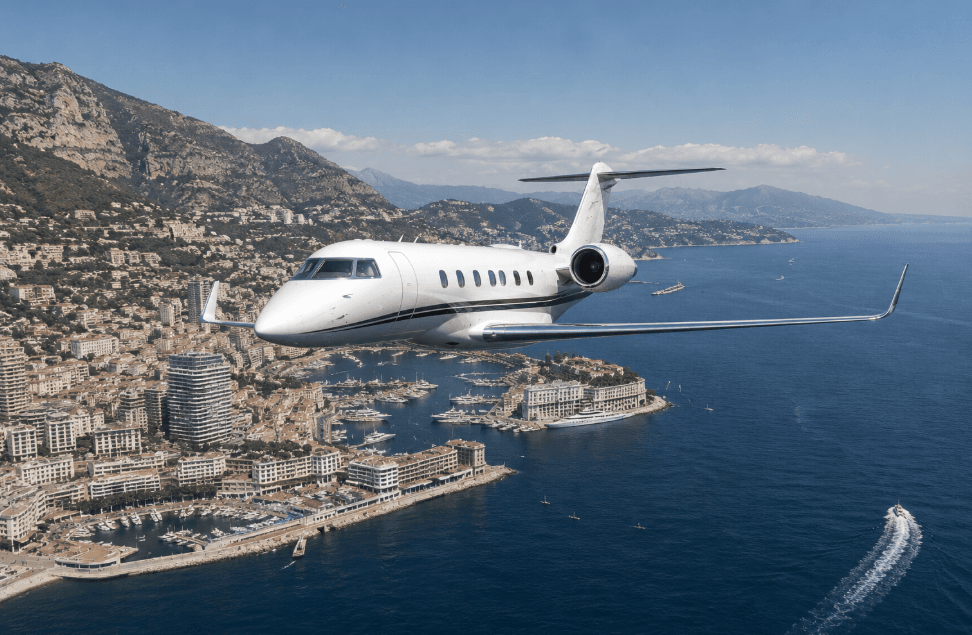
Monaco occupies a uniquely influential position within the global luxury economy. Despite covering less than one square mile, the principality functions as one of the world’s densest concentrations of wealth, financial capital, luxury tourism, international events, and elite mobility activity. Its significance extends far beyond geography, operating instead as a strategic hub where global finance, yachting, motorsport, real estate, and executive travel converge within an exceptionally compressed urban environment.
This density creates a highly specialized operational ecosystem in which efficiency, precision, discretion, and coordination become essential infrastructure components. In Monaco, space limitations, transportation congestion, event-driven demand surges, and high-profile international activity require private aviation systems capable of functioning with extraordinary logistical accuracy.
Unlike larger metropolitan aviation markets, Monaco’s mobility structure depends heavily upon interconnected regional infrastructure involving executive airports, helicopter transfers, yacht coordination, luxury hospitality networks, and tightly synchronized scheduling systems. Private aviation therefore plays a foundational role in supporting the principality’s broader economic and social architecture.
As global wealth becomes increasingly mobile and internationally distributed, Monaco continues serving as a critical case study in how luxury density reshapes aviation operations, executive mobility, and infrastructure planning within elite global markets.
Monaco’s most defining characteristic is spatial limitation. The principality’s geographic compression creates extraordinary infrastructure pressure across transportation, hospitality, residential development, and event management systems.
Unlike larger luxury destinations, Monaco operates without a dedicated airport. Instead, private aviation activity depends primarily on nearby infrastructure such as:
This dependency creates a highly integrated regional aviation environment where timing and logistical synchronization are essential.
Monaco’s limited territory contributes directly to its economic exclusivity. High real estate values, concentrated financial activity, and restricted access reinforce the principality’s global reputation as a center of elite wealth preservation and luxury living.
This concentrated economic structure generates substantial private aviation demand involving:
Aviation systems operating within Monaco’s ecosystem must therefore accommodate exceptional demand intensity within highly constrained physical conditions.
Because Monaco lacks a conventional airport, Nice Côte d’Azur Airport functions as the primary aviation gateway serving the principality.
The airport supports:
Its strategic proximity allows private aviation passengers to reach Monaco rapidly while bypassing many limitations associated with larger commercial transportation systems.
Operational complexity intensifies significantly during major international events such as:
These periods create concentrated surges in:
As a result, aviation planning within Monaco frequently requires extraordinary operational precision and advance coordination.
Monaco’s luxury economy operates within highly compressed scheduling environments where executives, investors, celebrities, and high-net-worth individuals often maintain tightly coordinated international itineraries.
Private aviation supports these mobility patterns by reducing:
Operational precision becomes especially important because even minor disruptions may create cascading logistical complications across interconnected schedules involving yachts, hotels, events, and business meetings.
Private aviation operators serving Monaco increasingly rely upon:
These systems allow mobility networks to function efficiently despite spatial limitations and high operational density.
Helicopter transportation plays an unusually important role within Monaco’s mobility ecosystem.
Transfers between Nice Airport and Monaco are frequently conducted by helicopter because of:
This vertical mobility infrastructure allows passengers to move efficiently between aviation gateways, yachts, hotels, and residential properties.
Monaco increasingly functions through interconnected transportation layers involving:
These systems operate as unified mobility ecosystems rather than isolated transportation services.
The efficiency of this coordination significantly influences passenger experience and operational continuity.
Monaco maintains one of the world’s highest concentrations of ultra-high-net-worth residents relative to population size.
This concentration generates consistent private aviation demand linked to:
Unlike seasonal resort markets, Monaco supports substantial year-round executive aviation activity because of its role as a financial and residential center.
Many Monaco-based individuals operate across multiple international jurisdictions simultaneously.
Private aviation supports efficient connectivity between Monaco and destinations such as:
This mobility network reflects the increasingly globalized nature of wealth management and executive coordination.
Despite its exclusivity, Monaco remains one of the world’s most publicly visible luxury destinations.
The principality attracts:
As a result, privacy and controlled mobility become operational priorities for many travelers.
Private aviation supports discretion through:
For many high-profile individuals, mobility itself becomes part of broader reputation and security management strategies.
Private aviation minimizes exposure to:
In elite environments such as Monaco, discretion often functions as a critical component of luxury service infrastructure.
Monaco’s economy operates through highly integrated luxury sectors involving:
Private aviation supports the continuity of these systems by enabling rapid international mobility between interconnected luxury environments.
The Monaco Yacht Show and broader Mediterranean yachting culture create substantial overlap between maritime luxury and executive aviation.
Passengers frequently coordinate movement between:
This integrated mobility model represents one of Monaco’s defining operational characteristics.
Given Monaco’s infrastructure limitations, predictive operational intelligence is increasingly important.
Modern aviation systems now analyze:
These technologies improve operational efficiency within highly constrained luxury environments.
Integrated digital platforms increasingly support:
These tools reduce friction and improve continuity across Monaco’s dense mobility ecosystem.
As private aviation expands globally, luxury destinations such as Monaco face growing environmental scrutiny involving:
The visibility of elite mobility in Monaco intensifies public attention surrounding aviation sustainability.
Operators increasingly focus on:
These initiatives aim to balance luxury mobility expectations with evolving environmental standards.
As global wealth mobility becomes more complex, Monaco’s aviation ecosystem will likely require even greater operational coordination involving:
Precision and adaptability will remain central competitive advantages.
Monaco increasingly functions as a global model demonstrating how concentrated wealth environments reshape transportation systems.
Its aviation ecosystem illustrates how:
can combine to create highly specialized operational environments requiring exceptional coordination and technological sophistication.
In the coming decade, Monaco will likely continue influencing how elite mobility systems evolve within other high-density luxury markets worldwide.