


Charter Flights

Available Fleet

Blog
Contacts


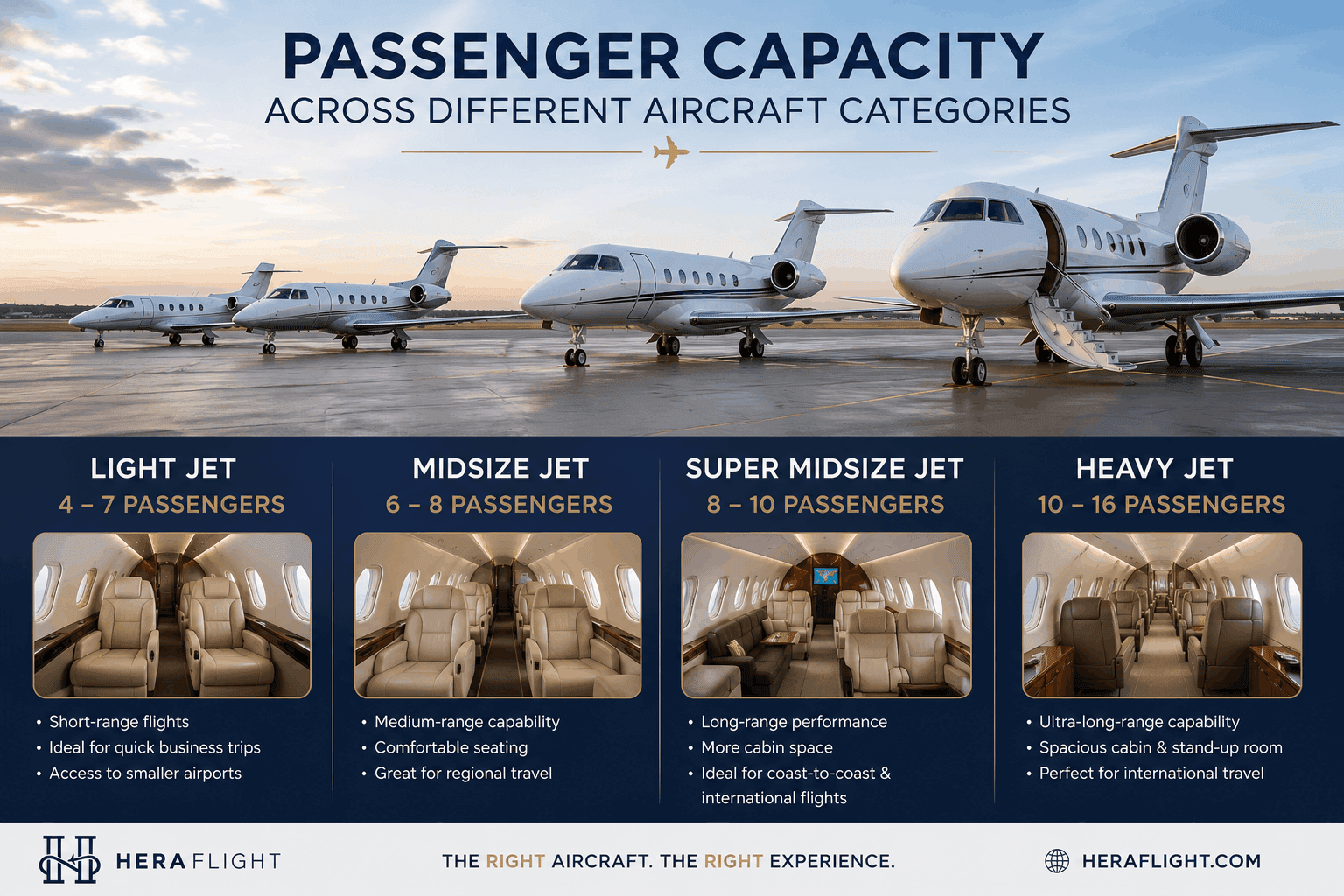
Selecting the appropriate aircraft is one of the most important decisions in private aviation. While factors such as range, comfort, operating costs, and airport accessibility all influence aircraft selection, passenger capacity remains a primary consideration for both charter clients and aircraft owners. Understanding how capacity varies across different aircraft categories enables travelers to choose solutions that align with operational requirements while ensuring comfort, efficiency, and cost-effectiveness.
In private aviation, passenger capacity is not simply a matter of how many seats are installed in an aircraft. Cabin dimensions, seating configurations, baggage requirements, flight duration, and onboard amenities all affect the practical number of passengers that can be accommodated comfortably. An aircraft certified for eight passengers may not always be the ideal choice for eight travelers on a transcontinental journey, particularly when luggage, personal space, and mission objectives are considered.
This article examines passenger capacity across the major categories of private aircraft and explores the factors that influence aircraft selection for different travel scenarios.
Unlike commercial airlines, which maximize seating density to increase revenue per flight, private aircraft prioritize comfort, flexibility, and operational performance. As a result, the number of available seats often differs from the number of passengers that can be accommodated comfortably.
Several variables influence practical passenger capacity:
Consequently, experienced aviation advisors evaluate capacity requirements holistically rather than focusing solely on seat count.
Very Light Jets represent the entry point into the private jet market and are designed primarily for short regional missions.
Typical Passenger Capacity
Representative Aircraft
Operational Characteristics
VLJs provide an economical solution for short-distance travel and offer access to smaller airports that may not accommodate larger aircraft. Their compact cabins are well-suited to business travelers, couples, or small families on flights of up to two or three hours.
While these aircraft are efficient and cost-effective, cabin space is limited, and baggage capacity may be restricted. As a result, VLJs are generally most appropriate for smaller travel parties with modest luggage requirements.
Light jets are among the most frequently chartered aircraft categories due to their balance of affordability, performance, and passenger comfort.
Typical Passenger Capacity
Representative Aircraft
Operational Characteristics
Compared to VLJs, light jets offer larger cabins, increased baggage capacity, and greater range. They are particularly popular for domestic business travel and regional leisure trips.
For groups of six or fewer passengers, light jets often provide an ideal balance between comfort and operational efficiency. However, flights approaching maximum passenger capacity may reduce available luggage space depending on aircraft type and mission length.
Midsize jets occupy an important position in private aviation, offering enhanced comfort without the operating costs of larger aircraft.
Typical Passenger Capacity
Representative Aircraft
Operational Characteristics
Midsize aircraft offer stand-up cabin sections, enclosed lavatories, and improved baggage storage. Their range allows for longer domestic and select international routes while maintaining a comfortable passenger environment.
For executive teams and families traveling medium distances, midsize jets often represent an optimal solution.
The super-midsize category has become increasingly popular among both corporate and leisure travelers for combining long-range performance with spacious cabin accommodations. Typical Passenger Capacity: 8 to 10 passengers. Representative Aircraft: Bombardier Challenger 350, Gulfstream G280, Citation Longitude. Operational Characteristics: Super-midsize jets offer significant improvements in cabin comfort, headroom, luggage capacity, and onboard productivity. Many feature fully enclosed lavatories, advanced entertainment systems, and reliable high-speed connectivity.
Typical Passenger Capacity
Representative Aircraft
Operational Characteristics
Super-midsize jets offer significant improvements in cabin comfort, headroom, luggage capacity, and onboard productivity. Many feature fully enclosed lavatories, advanced entertainment systems, and reliable high-speed connectivity.
These aircraft are well-suited to transcontinental missions and medium-range international flights, making them a preferred choice for travelers seeking premium comfort without switching to larger jets.
Heavy jets are designed for long-distance travel and offer significantly larger cabins that accommodate diverse passenger needs.
Typical Passenger Capacity
Representative Aircraft
Operational Characteristics
Heavy jets provide multiple cabin zones that support work, dining, and relaxation simultaneously. Their larger dimensions make them particularly attractive for corporate delegations, extended families, and VIP travel.
In addition to increased passenger capacity, heavy jets offer larger baggage compartments, enhanced catering capabilities, and superior cabin comfort on long-haul flights.
Ultra-long-range aircraft represent the highest tier of private aviation and are designed for nonstop intercontinental travel.
Typical Passenger Capacity
Representative Aircraft
Operational Characteristics
These aircraft combine exceptional range with luxurious cabin environments. Multiple living areas, conference facilities, private suites, and dedicated sleeping accommodations are common features.
For international business travel, diplomatic missions, and family journeys involving extended flight durations, ultra-long-range aircraft deliver unmatched capability and comfort.
At the upper end of the private aviation spectrum are executive airliners derived from commercial aircraft platforms.
Typical Passenger Capacity
Representative Aircraft
Operational Characteristics
These aircraft are frequently configured according to owner specifications and may include conference rooms, bedrooms, lounges, dining facilities, and staff accommodations.
Executive airliners are commonly used by governments, royal families, multinational corporations, and ultra-high-net-worth individuals requiring exceptional space and flexibility.
While seat capacity serves as a useful starting point, several additional considerations influence aircraft suitability.
Flight Duration
Longer flights typically require greater personal space. An aircraft suitable for eight passengers on a one-hour flight may feel considerably less comfortable during a ten-hour international journey.
Baggage Requirements
Passenger luggage often influences aircraft selection as much as passenger count itself. Ski equipment, golf clubs, business materials, and family travel necessities can significantly affect available capacity.
Cabin Configuration
Certain aircraft prioritize passenger comfort through club seating arrangements, conference areas, and divans. These layouts may reduce available seating while enhancing the overall travel experience.
Sleeping Accommodations
For overnight and ultra-long-range missions, sleeping arrangements become increasingly important. Larger aircraft frequently provide lie-flat seating and dedicated rest areas.
Selecting the ideal aircraft requires balancing multiple operational variables rather than focusing exclusively on maximum passenger capacity.
Experienced charter professionals typically evaluate:
This comprehensive approach ensures that travelers receive an aircraft solution optimized for both efficiency and comfort.
Aircraft manufacturers continue to invest in innovative cabin designs that maximize usable space while improving the passenger experience.
Recent developments include:
These innovations allow modern aircraft to accommodate passengers more comfortably than previous generations while maintaining operational efficiency.
Passenger capacity remains one of the most important considerations in private aviation, yet selecting an aircraft effectively requires a broader understanding of operational requirements and passenger expectations. From very light jets accommodating small travel parties to executive airliners capable of transporting large delegations, each aircraft category serves a distinct role within the aviation ecosystem.
By evaluating factors such as flight duration, cabin space, baggage requirements, and onboard amenities alongside passenger count, travelers can identify aircraft solutions that deliver the highest levels of efficiency, comfort, and value. Ultimately, the right aircraft category is the one that best aligns passenger capacity with the mission at hand.
At Hera Flight, we help clients navigate the complexities of aircraft selection by matching mission requirements with the most suitable aircraft category. Through careful planning and expert guidance, travelers can ensure that every journey benefits from the ideal balance of performance, comfort, and operational excellence.