



Charter Flights

Empty Leg Flights
Available Fleet
Blog
Contacts


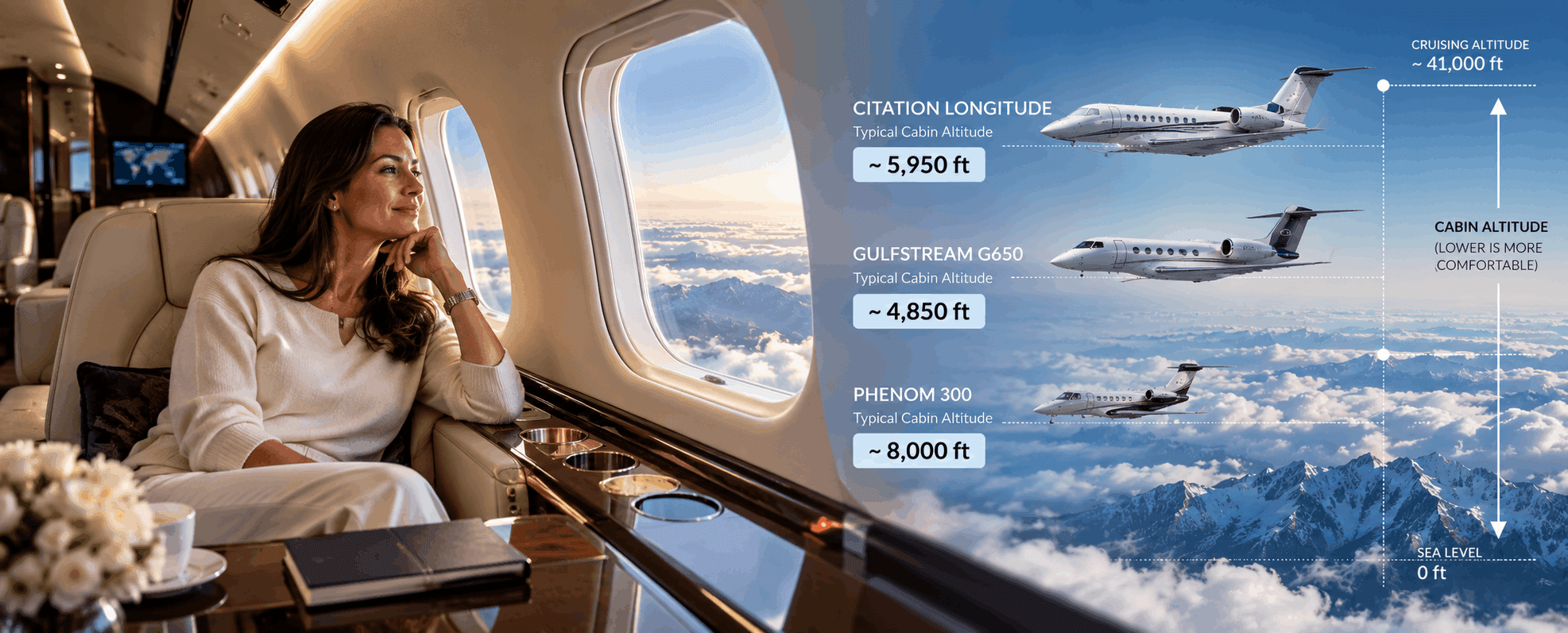
Long private jet flights are often associated with spacious cabins, quiet interiors, and personalized service, but one less visible factor can have a major impact on passenger comfort: cabin altitude.
Even when an aircraft is cruising at 40,000 feet or higher, passengers are not exposed to the same atmospheric conditions as the air outside. The cabin is pressurized to create an environment that feels more like being at a much lower elevation.
Different aircraft maintain different cabin altitudes, and that difference can affect how passengers feel during and after a long flight.
Cabin altitude is the equivalent altitude created inside a pressurized aircraft. For example, an aircraft may be flying at 41,000 feet while maintaining a cabin environment that feels similar to being at an elevation of several thousand feet above sea level.
The lower the cabin altitude, the closer the pressure inside the aircraft is to conditions experienced on the ground. This matters because the human body responds to changes in air pressure and available oxygen.
At typical private jet cruising altitudes, the outside air is too thin for normal breathing without supplemental oxygen. Pressurization systems maintain a safe and comfortable cabin environment by controlling the pressure inside the aircraft.
The system does not usually keep the cabin at sea-level pressure because doing so would require the aircraft structure to withstand a much greater pressure difference between the inside and outside. Instead, the cabin is maintained at a lower equivalent altitude that balances passenger comfort with aircraft design requirements.
As altitude increases, atmospheric pressure decreases. That means there is less oxygen available with each breath, even though the percentage of oxygen in the air remains essentially the same.
At moderate cabin altitudes, healthy passengers generally tolerate these conditions well. However, over several hours, some travelers may notice fatigue, mild headaches, dryness, or a general feeling of being less refreshed.
An aircraft capable of maintaining a lower cabin altitude can reduce the degree of pressure-related stress experienced during a long flight.
On a short regional flight, the difference between aircraft pressurization systems may not be particularly noticeable. On a flight lasting eight, ten, or more hours, comfort factors become more important.
Passengers spend more time exposed to the cabin environment, so pressure, humidity, noise, seating, lighting, and temperature can all affect how they feel on arrival. This is one reason long-range private jets often emphasize cabin altitude as part of their comfort design.
Aircraft models vary significantly in their pressurization capabilities. Some newer long-range jets are designed to maintain relatively low cabin altitudes even while cruising at very high flight levels.
Other aircraft may operate with a higher cabin altitude under similar conditions. The exact cabin altitude can also vary depending on actual cruising altitude and aircraft systems.
Travelers comparing aircraft for long flights may therefore want to consider pressurization alongside range, cabin size, and seating configuration.
Private jets are capable of flying at high altitudes for efficiency, weather avoidance, and access to less congested airspace. A modern aircraft with an advanced pressurization system may cruise very high while still maintaining a comfortable cabin environment.
The altitude shown on a flight-tracking display does not directly tell passengers what conditions are like inside the cabin. Two aircraft flying at the same altitude may maintain different cabin pressures.
Long-distance travel can be tiring for many reasons. Time-zone changes, disrupted sleep, sitting for extended periods, dehydration, and changes in routine all contribute.
Cabin altitude is only one factor, but it can influence the overall experience. A lower cabin altitude may help passengers feel less fatigued, particularly when combined with a quiet cabin, comfortable seating, appropriate hydration, and opportunities to rest.
Aircraft cabins tend to have relatively dry air. Low humidity can contribute to dry skin, irritated eyes, and throat discomfort during long flights.
Some newer private jets use cabin systems designed to create a more comfortable overall environment, including improved humidity management. Cabin altitude and humidity are separate characteristics, but passengers often experience them together.
Cabin altitude is not fixed throughout the entire flight. As the aircraft climbs, the pressurization system gradually changes cabin pressure. The same process happens in reverse during descent.
Passengers may notice pressure changes in their ears during these phases. Modern systems are designed to manage these transitions smoothly.
People respond differently to cabin pressure. Some passengers barely notice the change, while others experience ear pressure, sinus discomfort, or headaches.
Colds, allergies, congestion, and individual sensitivity can make pressure changes more noticeable. Children may also experience ear discomfort because they may have more difficulty equalizing pressure during climb and descent.
Aircraft designed for long-distance missions must provide more than range. Passengers may spend a significant portion of a day onboard, so manufacturers often focus heavily on cabin comfort.
This can include lower cabin altitude, quieter interiors, better lighting, larger windows, improved temperature control, and more flexible seating arrangements.
A large cabin does not automatically mean a low cabin altitude. Cabin dimensions describe physical space, while cabin altitude describes pressurization.
Both can influence comfort, but in different ways. A larger cabin may provide more room to stand, move, work, or sleep. A lower cabin altitude can reduce the physiological impact of spending many hours at cruising altitude.
No. Jet lag is primarily related to disruption of the body's circadian rhythm when traveling across time zones.
A lower cabin altitude does not prevent that biological adjustment. However, a more comfortable cabin environment may help reduce some of the general fatigue associated with a long journey.
Travelers often choose private jets based on range, passenger capacity, cabin size, or price. For long-range travel, cabin altitude is another useful specification to understand.
An aircraft that maintains a lower cabin altitude can create an environment that feels closer to conditions on the ground, which may improve comfort over many hours of flying. The most comfortable aircraft is not simply the one with the largest cabin, but the one that combines the right range, space, seating, noise level, and pressurization characteristics for the journey ahead.