



Charter Flights

Empty Leg Flights
Available Fleet
Blog
Contacts


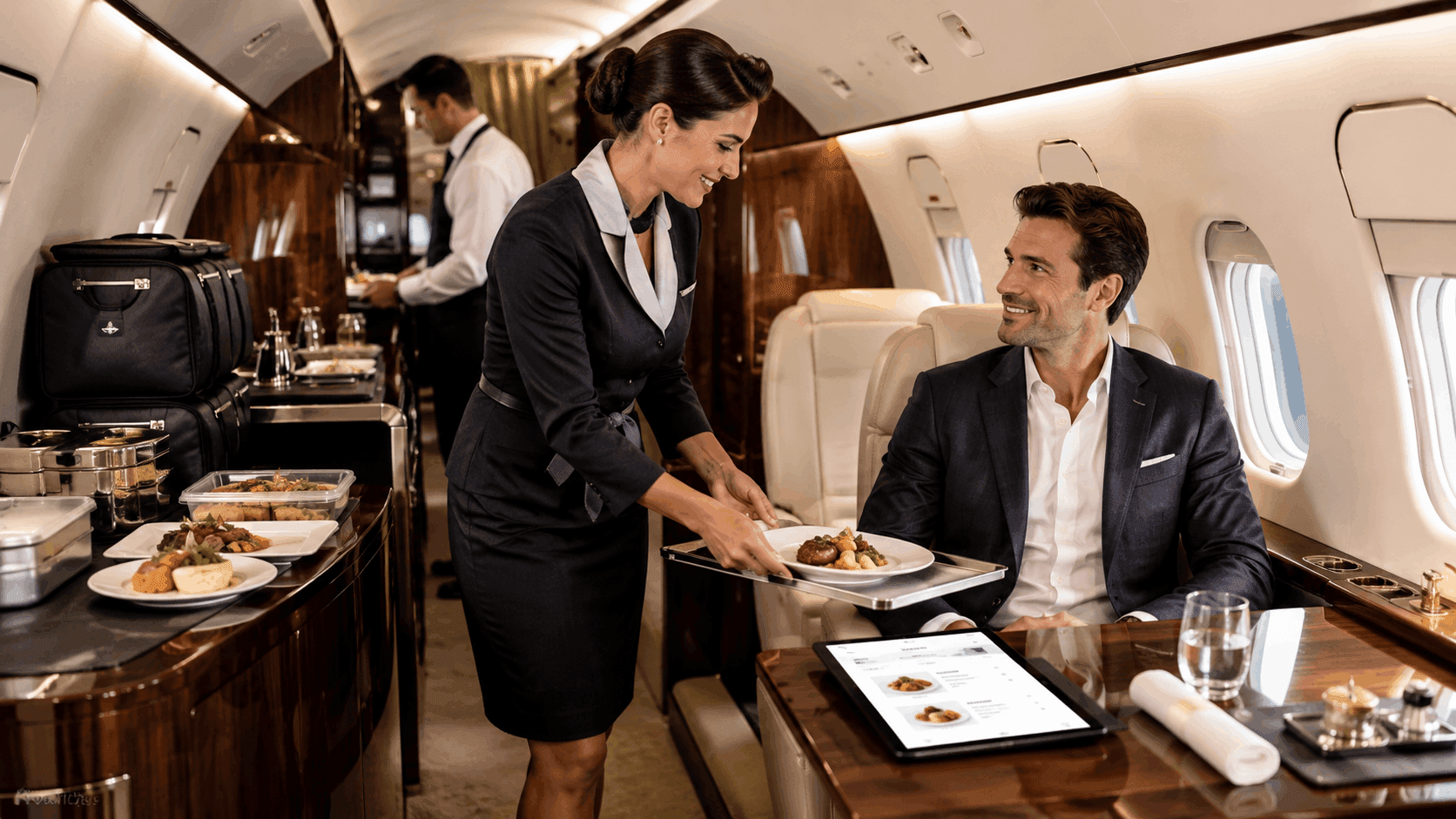
Private jet catering is designed around flexibility. Unlike scheduled airline service, where passengers select from a limited menu prepared for hundreds of travelers, private aviation allows meals to be planned around a specific group, itinerary, aircraft, departure time, and set of dietary preferences.
That flexibility does not mean that any dish can simply be ordered and served exactly as it would be in a restaurant. Private aircraft have different galley layouts, storage capacities, refrigeration options, heating equipment, and cabin environments. Food must also be prepared, packaged, transported through airport security procedures, loaded onto the aircraft, stored safely, and presented appropriately once the flight is underway.
The result is a catering process that combines hospitality with logistics. A successful menu needs to satisfy passenger preferences while remaining practical for the aircraft and route.
Commercial airlines generally build food programs around standardization. Meals must work across large fleets, fixed schedules, and hundreds or thousands of passengers.
Private aviation operates differently.
A charter flight may carry only a few travelers, allowing catering to be organized around individual requests rather than a mass-market menu.
Passengers may request:
The ability to personalize the experience is one of the defining characteristics of private aviation catering.
However, customization still has to fit within operational realities.
Catering is normally arranged before the flight, often during the charter-booking or trip-confirmation process.
The earlier passengers provide their preferences, the more options the operator or flight-support team has.
Advance notice is particularly valuable when the request involves:
A straightforward request for sandwiches, fruit, snacks, and drinks can generally be arranged more easily than an elaborate menu requiring specialized preparation.
International departures can also require more planning because suitable catering suppliers may vary by airport.
The exact process depends on the charter provider and airport.
Catering may be coordinated by:
The passenger usually communicates preferences to one point of contact. The operational team then determines how those requests can be fulfilled at the departure airport.
At major private aviation hubs, specialist caterers may provide extensive menus specifically designed for aircraft.
At smaller airports, catering may come from local restaurants, hotels, or other approved food providers.
A private jet menu usually begins with several practical questions.
The catering team may need to know:
A two-hour morning flight might require only breakfast and coffee.
A seven-hour international flight may involve several service periods, snacks, beverages, and more extensive meal planning.
This is why catering should be designed around the entire mission rather than simply creating a restaurant-style menu.
Early private jet departures commonly require breakfast service.
Typical options may include:
Passengers who want hot food should confirm what reheating equipment is available aboard the aircraft.
Some aircraft can accommodate substantial hot-meal service, while others are better suited to cold or lightly reheated dishes.
Business travelers often prefer food that is practical to eat while working.
Suitable dishes can include:
Foods that require complicated plating or create strong aromas may be less convenient in a smaller cabin.
For working lunches, the objective is often to provide a meal that is satisfying without disrupting meetings or requiring extensive cabin service.
Larger private aircraft can support more elaborate meal service.
A dinner menu might include:
The experience can resemble restaurant dining, but dishes still need to be selected with aircraft limitations in mind.
Foods that retain their texture and flavor after transportation and reheating are often better choices than dishes that depend on immediate preparation.
Aircraft size has a major influence on what can realistically be served.
A light jet and a large-cabin business jet may both transport the same small group of passengers, but their catering capabilities can be substantially different.
Important factors include:
A smaller aircraft may have limited space for food preparation and service.
Larger aircraft can often support more sophisticated meal presentation and multiple service courses.
Passengers requesting elaborate catering should therefore consider the capabilities of the aircraft itself.
Private jet galleys vary considerably.
Depending on the aircraft, equipment may include:
The galley is generally intended for storing, heating, assembling, and presenting meals rather than cooking them from raw ingredients.
Most private aviation catering is prepared on the ground.
Food is then packaged so it can be safely transported and reheated or served aboard the aircraft.
Cabin conditions can affect the way food tastes and feels.
For this reason, private aviation caterers often favor dishes that maintain quality during transport, storage, and reheating.
Good choices can include:
Foods that deteriorate rapidly or rely heavily on crisp textures can be more difficult to serve successfully.
The goal is not merely to prepare an excellent dish on the ground. It is to make sure it remains appealing when served later in an aircraft cabin.
One of the advantages of private aviation is that passenger preferences can often be recorded and incorporated into future flights.
Frequent travelers may develop consistent requests such as:
For repeat travelers, this can reduce the amount of planning required before each journey.
The catering experience becomes part of the broader personalized service associated with private aircraft travel.
Dietary requirements should be communicated clearly and as early as possible.
Common requests include:
The level of specialization available can depend on the departure airport and local suppliers.
Large aviation hubs generally offer more options than remote destinations.
For strict requirements, passengers should distinguish between a preference and a medically necessary restriction so that the caterer can take the appropriate precautions.
Food allergies should be treated differently from ordinary menu preferences.
Passengers should identify:
Common allergens include:
Private catering can provide a high level of customization, but no food-production environment should be assumed to be completely allergen-free unless this has been specifically confirmed.
Clear communication is therefore essential.
Religious dietary requirements may involve more than simply avoiding particular ingredients.
Kosher or halal meals may need to come from specialized certified suppliers.
Availability depends heavily on airport location.
At major cities, specialist meals may be relatively easy to arrange with sufficient notice.
At remote airports, they may need to be transported from another location, which can increase both preparation time and cost.
Advance planning is particularly important for these requests.
Families traveling privately can customize catering for younger passengers.
Children’s options might include:
Parents may also request specific brands or foods that children already know.
This can be useful on long flights where an unfamiliar menu could make the journey less comfortable.
Meals can also be timed around a child’s normal eating schedule rather than a predetermined airline service routine.
Longer flights require more detailed catering planning.
A long-range itinerary may involve several meal periods.
For example:
Departure: afternoon
Flight duration: 10 hours
The catering plan could include:
The number of meals should be balanced carefully. Excessive catering consumes storage space and creates unnecessary waste, while insufficient food can be inconvenient on a long flight.
The planned departure and arrival times are therefore important when building the menu.
Overnight flights often require a different strategy.
Passengers may prefer to eat shortly after departure and then sleep for most of the journey.
A typical service plan might be:
Heavy meals may be avoided if passengers want to rest.
The cabin schedule can be coordinated around sleeping arrangements and destination time.
International private aviation introduces another consideration: time zones.
A meal plan can follow:
Travelers trying to adjust quickly to a new time zone may prefer meals aligned with their destination.
For example, passengers departing the United States for Europe in the evening may eat dinner shortly after takeoff and then sleep, helping them adjust to the morning arrival.
Catering planning can therefore contribute to the overall travel strategy.
Passengers sometimes request food from a particular restaurant.
This may be possible, depending on:
Restaurant food is not automatically optimized for aircraft service.
Items may need to be repackaged into appropriate containers before being loaded.
Some dishes also travel better than others.
A charter concierge or caterer may therefore recommend alternatives when a requested restaurant dish is unlikely to maintain its quality.
Private aviation catering can also incorporate local cuisine.
Passengers departing Italy might request regional pasta or antipasti, while travelers leaving Japan may prefer sushi or a Japanese meal.
Local sourcing can make the flight experience more distinctive and can sometimes provide better results than attempting to recreate regional food far from its origin.
However, preparation and storage requirements must still be considered.
The logistics behind private jet catering are often invisible to passengers.
Once meals are prepared, they must be:
Timing is important.
Food should arrive close enough to departure to remain fresh but early enough to avoid delaying the aircraft.
Flight delays can complicate this process because some dishes have limited safe storage periods.
Fixed-Base Operators, or FBOs, frequently serve as the point where private jet catering enters the airport environment.
The FBO may:
At airports with extensive private aviation traffic, this process can be highly streamlined.
At smaller airports, more coordination may be necessary.
Packaging needs to perform several functions.
It should:
Catering for an aircraft is therefore packaged differently from a standard restaurant takeout order.
Items may be separated into individual containers so the crew can assemble them immediately before service.
Sauces and dressings are frequently packaged separately to preserve texture.
Maintaining safe food temperatures is essential throughout the catering process.
Meals may pass through several stages:
Hot and cold items need appropriate handling during each stage.
This is particularly important for foods such as:
Professional aviation caterers generally design their processes around these logistical requirements.
Meals intended to be served hot are normally cooked on the ground and reheated aboard.
The available method depends on aircraft equipment.
Food may be reheated using:
Some foods respond better to reheating than others.
Private aviation caterers therefore often modify preparation methods specifically for aircraft service.
For example, sauces might be added after reheating rather than before, helping prevent a dish from drying out.
Private jet catering is not limited to food quality.
Presentation can be part of the experience.
Depending on aircraft size and cabin service, meals may be served using:
A flight attendant may plate each course immediately before service.
On smaller aircraft without dedicated cabin crew, meals may be packaged more simply so passengers or pilots can manage service efficiently.
The expected level of presentation should match the aircraft and staffing arrangement.
Larger charter aircraft may operate with a dedicated flight attendant.
The flight attendant can manage:
Experienced cabin crew can also help refine catering orders before departure.
They understand which dishes work well on the aircraft and how much food is appropriate for the journey.
On smaller private jets, there may be no flight attendant, so catering needs to be considerably simpler.
Beverages are another important component of private aviation catering.
Common requests include:
Preferences can be highly specific.
Passengers may request particular brands, coffee styles, or non-dairy milk alternatives.
Beverages also require considerable storage, especially on longer journeys.
Over-ordering can therefore consume valuable galley space.
Private jets are sometimes used for personal celebrations.
Catering requests might involve:
Passengers may request:
Certain items must be selected carefully because aircraft cabins offer limited space and movement.
A large decorative cake, for example, may need special packaging to reach the aircraft without damage.
Corporate flights may require catering designed around meetings and productivity.
Suitable options can include:
Strong-smelling or difficult-to-eat foods may be avoided so that passengers can continue working comfortably.
For group transportation, meals can also be labeled individually to account for different dietary requirements.
Food does not exist independently of aircraft loading.
Catering containers, beverages, ice, service equipment, and supplies all occupy space and contribute weight.
On smaller aircraft, unusually elaborate catering can reduce available storage.
This is another reason catering should be considered during trip planning rather than after the aircraft has already been loaded.
For a short flight with significant baggage, a simpler menu may be preferable.
Short and long flights require very different catering strategies.
Suitable options may include:
Travelers may request:
Long missions can involve:
The menu should reflect how much time passengers will actually spend eating rather than simply how many options can be loaded.
Not every departure airport offers the same catering possibilities.
Major private aviation airports often have access to:
A smaller regional airport may have a more limited selection.
In some cases, food can be transported from a nearby city, although longer delivery distances can increase cost and reduce flexibility.
Passengers with highly specific requests should therefore provide advance notice when departing from smaller airports.
International flights can introduce additional considerations.
Some countries restrict the importation of certain agricultural and food products.
Items such as:
may be subject to destination-specific rules.
Food that is permitted to be consumed during the flight may not necessarily be allowed to enter the destination country.
Crew members manage these issues as part of international flight procedures, but passengers should avoid assuming that all leftover catering can be taken off the aircraft after arrival.
Catering prices vary substantially.
Costs depend on:
A simple breakfast can cost substantially less than an elaborate multi-course meal from a premium supplier.
Airport delivery itself can also affect pricing because catering must reach a secure aviation environment at a specific time.
Whether catering is included depends on the charter arrangement.
Some flights may include a standard selection of:
More extensive requests may be charged separately.
Premium catering, restaurant orders, specialty products, and unusual dietary requirements can add to the charter cost.
When arranging private aviation by Hera Flight, passengers can discuss catering requirements as part of the broader charter planning process so that menu preferences can be coordinated with the aircraft, route, departure airport, and flight duration.
Clarifying catering expectations before booking helps distinguish standard onboard provisions from additional personalized services.
Private aviation offers flexibility, but catering still involves preparation and delivery.
A request made shortly before departure may be limited by:
Simple changes can often be accommodated more easily than highly specialized requests.
For the widest menu selection, passengers should communicate preferences as early as practical.
A delayed flight creates additional challenges.
Cold meals may remain usable if stored correctly, but certain hot dishes can lose quality over time.
A substantial delay may require:
Specialist aviation caterers and flight crews take departure timing into account when coordinating delivery.
Private jet passengers sometimes assume that more food automatically produces a better experience.
In practice, excessive catering creates several problems.
It can:
For shorter journeys, a carefully selected menu can provide a better experience than an excessive assortment.
Experienced charter teams often recommend quantities based on passenger number and flight duration.
Food waste is increasingly relevant in aviation hospitality.
Customized ordering can help reduce waste because the caterer knows exactly how many passengers will travel and what they prefer.
More efficient planning can include:
Accurate passenger preferences make it easier to provide high-quality catering without loading food that is unlikely to be consumed.
A practical catering process can follow several stages.
Identify the total number of passengers, including children.
Document allergies, religious requirements, and dietary preferences.
Determine whether the flight requires snacks, one meal, or several service periods.
Check galley equipment, storage space, and whether cabin crew will be available.
Choose foods that suit both passenger preferences and aircraft service conditions.
Coordinate preparation and delivery with the aircraft’s departure schedule.
Confirm branded products, restaurant sourcing, cakes, children’s food, or other specialized items.
Following this process reduces the likelihood of last-minute problems.
Before departure, passengers can provide the charter team with:
Providing specific information is generally more useful than simply asking for “premium catering.”
In most cases, yes. Private aviation catering can be customized around passenger preferences, dietary requirements, route, aircraft capabilities, and supplier availability.
Often, depending on the restaurant, airport, timing, and delivery logistics. The food may need to be repackaged before being loaded onto the aircraft.
Usually not from raw ingredients. Most meals are prepared on the ground and then stored, assembled, or reheated aboard.
No. Galley equipment varies considerably between aircraft. Some have ovens or microwave equipment, while smaller jets may support only basic food storage and service.
Caterers can often accommodate allergy-related requests, but passengers should communicate the specific allergen and severity in advance. Cross-contact risks should also be discussed when medically important.
Usually, particularly when adequate notice is provided. Availability can depend on the departure airport and local suppliers.
Often yes, especially at major aviation centers, but certified meals may require specialist suppliers and additional notice.
Standard snacks and beverages may be included in some charter arrangements, while premium catering and special requests may be billed separately. The quote or charter agreement should clarify what is included.
Yes. Children’s meals can generally be planned independently from the adult menu and may include familiar foods, snacks, drinks, or age-appropriate portions.
This may be possible, subject to operator, airport, security, storage, and destination regulations. International travel can introduce restrictions on transporting certain food products.
Availability depends on the charter arrangement, operator policies, destination regulations, and passenger requirements. Beverage preferences should be discussed during trip planning.
It depends on destination regulations. Certain meat, dairy, fruit, vegetables, and agricultural products may be restricted from entering a country and may need to remain onboard or be disposed of appropriately.
Simple catering may be possible with relatively short notice, but specialized menus, dietary requirements, specific restaurant orders, and international departures benefit from earlier planning.
Yes. Galley equipment, storage space, cabin size, and the availability of a flight attendant can all influence which foods can be served effectively.
Private jet catering is ultimately an exercise in combining personalization with practical flight operations. Passenger preferences shape the menu, but aircraft galley capabilities, route length, airport location, storage, food safety, and delivery logistics determine how that menu can be executed successfully.
The most effective catering plans are therefore created alongside the flight itself. By communicating dietary requirements, preferred foods, meal timing, and special requests in advance, passengers give the charter team the information needed to coordinate a menu that fits both the travelers and the aircraft.