



Charter Flights

Empty Leg Flights
Available Fleet
Blog
Contacts


Winter weather adds another layer of complexity to private aviation. Snow, freezing rain, frost, and ice can affect an aircraft before it ever leaves the ground, which is why deicing procedures are an essential part of many cold-weather departures.
For passengers, deicing may look like a short delay while ground crews spray the aircraft. In reality, it is a carefully controlled safety process designed to remove contamination from critical surfaces and help prevent ice from interfering with aircraft performance during takeoff.
Aircraft wings and control surfaces are designed to work with precise airflow. Even a relatively small amount of frost, snow, or ice can disrupt that airflow and reduce aerodynamic performance.
Contamination can affect lift, increase drag, and interfere with how the aircraft responds during takeoff. For this reason, pilots cannot simply depart with visible ice or snow on critical surfaces.
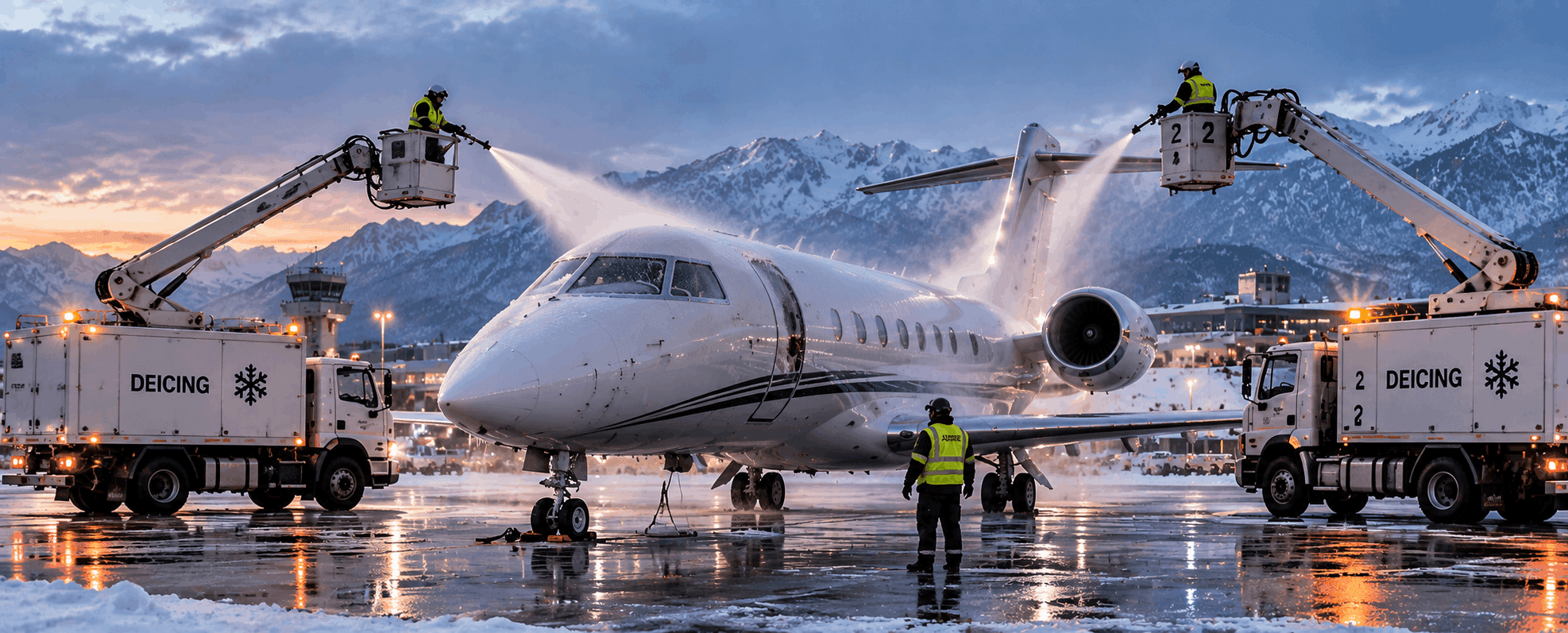
Deicing is the process of removing frost, snow, slush, or ice that has already accumulated on the aircraft. Ground crews typically use heated deicing fluid, which is sprayed over the wings, tail, fuselage, and other relevant surfaces.
Depending on the weather, this may be followed by another treatment designed to help prevent new ice from forming before takeoff.
Deicing removes contamination that is already present. Anti-icing helps protect the aircraft from additional accumulation for a limited period after treatment.
In active snow or freezing precipitation, both steps may be required. The fluids used can differ in composition and purpose, and the ground crew follows established procedures for their application.
Once an aircraft has been treated, the protection provided by anti-icing fluid does not last indefinitely. The effective period depends on precipitation type, temperature, intensity, fluid type, and weather conditions.
For that reason, deicing is usually performed as close to departure as practical. If the aircraft sits too long before takeoff, additional treatment may be required.
On many private flights, passengers board the aircraft before the deicing process begins. This allows the aircraft to be treated immediately before taxi and departure.
Passengers may hear or feel fluid striking the aircraft while seated inside the cabin. Although the process may look unusual from the window, it is a routine part of winter operations.
The aircraft is typically positioned in a designated deicing area or treated near its parking location. Specialized vehicles equipped with elevated spray booms apply heated fluid to the aircraft.
The process may take only a few minutes in light frost, while heavier snow or ice can require more time and fluid. Large aircraft or severe conditions may also need multiple treatment steps.
A thin layer of morning frost may require relatively simple treatment. Heavy snowfall, freezing rain, or rapidly accumulating precipitation can make the process more involved.
Temperature also matters because fluid performance changes in different conditions. Operators monitor weather closely so that the correct procedure can be used for the actual environment at the airport.
The aircraft may need to wait for a deicing truck, move to a centralized treatment area, or join a queue during periods of heavy snowfall. Busy airports can experience significant demand for deicing services when many aircraft need treatment at the same time.
Even private jets, which normally offer efficient boarding and departure procedures, can be affected by these operational constraints.
If the aircraft is treated but then experiences a long ground delay, protection may no longer be sufficient. The crew may need to return for additional deicing or anti-icing before takeoff.
This can happen if air traffic control delays departure, a runway closes temporarily, or snowfall becomes heavier than expected.
Even after the aircraft itself is clear of contamination, runway conditions can affect the flight. Snow, slush, or ice on the runway may increase takeoff distance and reduce braking effectiveness.
Pilots use current runway condition information when calculating aircraft performance. If conditions are too restrictive, the crew may need to delay departure, reduce aircraft weight, or wait for runway treatment.
Keeping a private jet in a heated or protected hangar can reduce the amount of snow and ice that accumulates before departure. However, deicing may still be necessary if precipitation is falling or contamination develops after the aircraft leaves the hangar.
Hangaring helps, but it does not eliminate the need for proper inspection before takeoff.
Pilots are responsible for confirming that the aircraft is suitable for departure. Before takeoff, the crew evaluates the condition of critical surfaces and considers whether additional treatment is required.
If there is uncertainty about contamination, the flight may be delayed until the aircraft can be inspected or treated again.
Deicing is one of the most visible safety procedures in winter private aviation. It can add time to the departure, but it serves a clear purpose: ensuring that the aircraft begins its takeoff with clean critical surfaces and appropriate protection against further contamination.
A short delay for deicing, an additional treatment after a ground hold, or extra time for runway preparation are all normal responses to changing conditions. Careful winter preparation protects the performance margins that make the flight safe from the moment it leaves the runway.