



Charter Flights

Empty Leg Flights
Available Fleet
Blog
Contacts


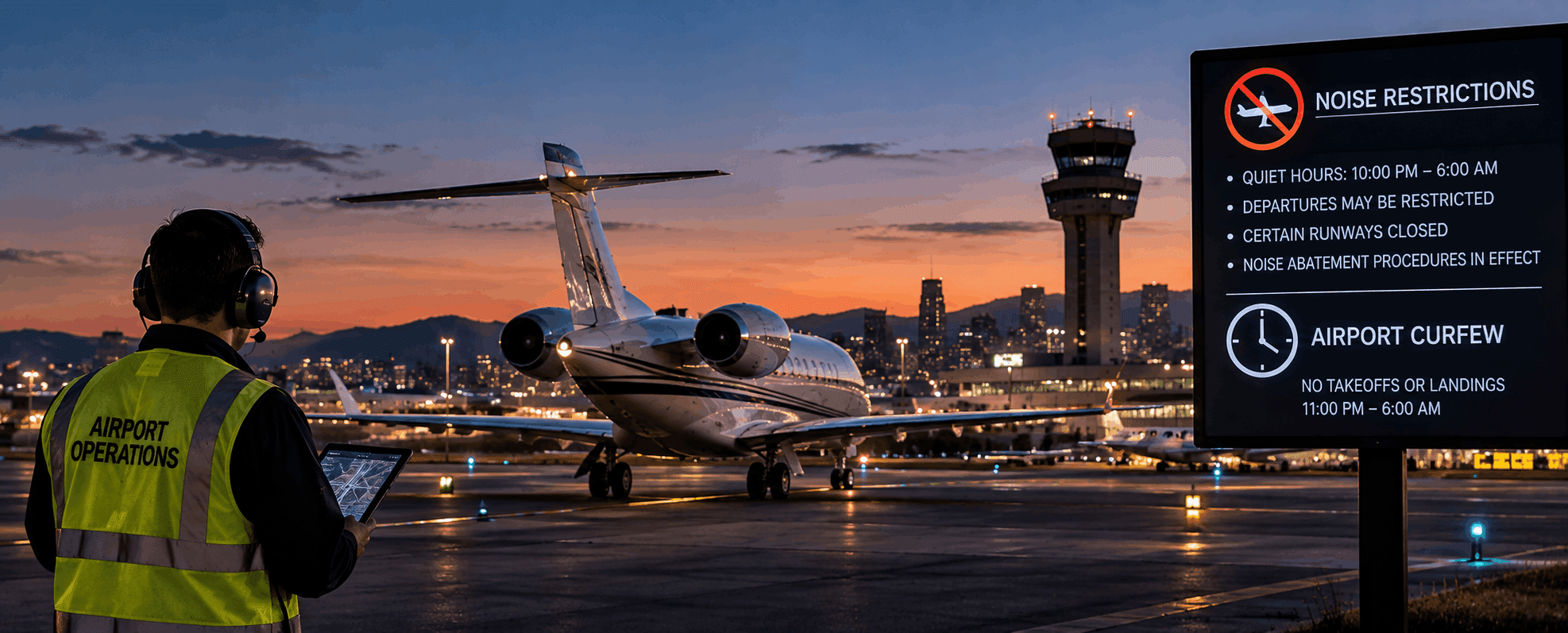
Private aviation offers travelers access to a wide range of airports and flexible departure times, but that flexibility is not unlimited. Many airports operate under local noise restrictions, curfews, or other rules designed to reduce the impact of aircraft activity on nearby communities.
For private jet travelers, these restrictions can affect which airport is available, what time a flight can depart or arrive, and whether an alternative airport may be required.
Airport noise restrictions are rules intended to limit the amount or type of aircraft noise generated around an airport. These rules can vary significantly from one location to another.
Some airports restrict certain aircraft based on certified noise levels. Others limit nighttime operations, require specific departure procedures, or apply additional fees to noisier aircraft. The purpose is generally to balance aviation access with the interests of surrounding communities.
An airport curfew is a restriction on aircraft operations during specific hours. For example, an airport may prohibit or limit departures and arrivals late at night and early in the morning.
Curfews may apply to all aircraft or only to certain categories of operation. Some airports allow limited exceptions for emergencies, medical flights, government operations, or aircraft that meet particular noise standards.
One of the advantages of private flying is the ability to build a schedule around the traveler. However, if the departure or destination airport has a nighttime curfew, that flexibility may be reduced.
A traveler planning a late-evening departure after a business dinner, for example, may discover that the preferred airport closes to certain operations before the meeting ends. In that case, the flight may need to depart earlier, use a different airport, or move to the following morning.
Two airports serving the same city may have very different operating restrictions. One may allow private jet activity throughout the night, while another may have strict curfew hours.
An airport located close to residential neighborhoods may also have tighter noise procedures than a larger airport situated farther from populated areas. If the most convenient airport is restricted, another airport in the same metropolitan region may still support the trip.
Noise restrictions may also depend on the aircraft itself. Modern private jets are generally designed to meet increasingly strict noise standards, but older aircraft may face additional restrictions at certain airports.
Some airports classify aircraft according to certified noise levels and may limit operations for aircraft that exceed local thresholds. In other cases, quieter aircraft may be allowed to operate during hours when other jets are restricted.
Noise management is not always about banning flights. Many airports use special operating procedures to reduce noise over nearby communities.
These may include specific departure routes, climb profiles, runway assignments, or limits on certain flight paths. From the passenger’s perspective, the flight may feel completely normal even though the crew is following a carefully designed noise-abatement procedure.
A private jet may originally be scheduled to arrive before an airport curfew, but weather, air traffic, or passenger delays can push the arrival later.
If the airport cannot accept the aircraft after the curfew begins, the operator may need to divert to another airport. This is one reason late-evening itineraries often require backup planning.
Some airports also restrict early departures. A traveler hoping to leave before sunrise may find that the preferred airport does not permit the planned operation until later in the morning.
This can affect business schedules, connecting travel, or same-day international itineraries. In some cases, using another nearby airport can preserve the desired departure time.
At busy airports, curfews may exist alongside slot requirements. A flight may need both permission to operate at a certain time and an available departure or arrival slot.
During major events or peak travel periods, these restrictions can become more important. An aircraft may be technically capable of using the airport but still be unable to secure the required operating window.
Some airports charge additional fees based on aircraft noise levels or time of operation. Late-night movements, certain aircraft categories, or operations during restricted periods may carry higher airport charges.
Travelers comparing airports should therefore consider both convenience and operating expenses. A slightly more distant airport may sometimes provide better availability and lower fees.
Noise restrictions and curfews are common at airports around the world, but the rules vary by country and airport. Local holidays, military activity, staffing limitations, and customs operating hours can also affect access.
International private flight planning may therefore require more lead time.
One of the strengths of private aviation is access to multiple airports within many metropolitan areas. If one airport has a curfew or noise limitation, another may offer a workable alternative.
The best option depends on runway suitability, ground travel time, aircraft type, operating hours, and local fees. In some cases, using a secondary airport may add a short drive but allow the traveler to depart or arrive at the preferred time.
Private aviation provides far more schedule flexibility than most forms of transportation, but every flight still operates within local airport rules.
Noise restrictions and curfews can influence aircraft selection, departure time, arrival time, and airport choice. With proper coordination, many restrictions can be managed through alternative airports, schedule adjustments, or different aircraft options while still preserving the flexibility travelers value.