


Charter Flights

Available Fleet

Blog
Contacts


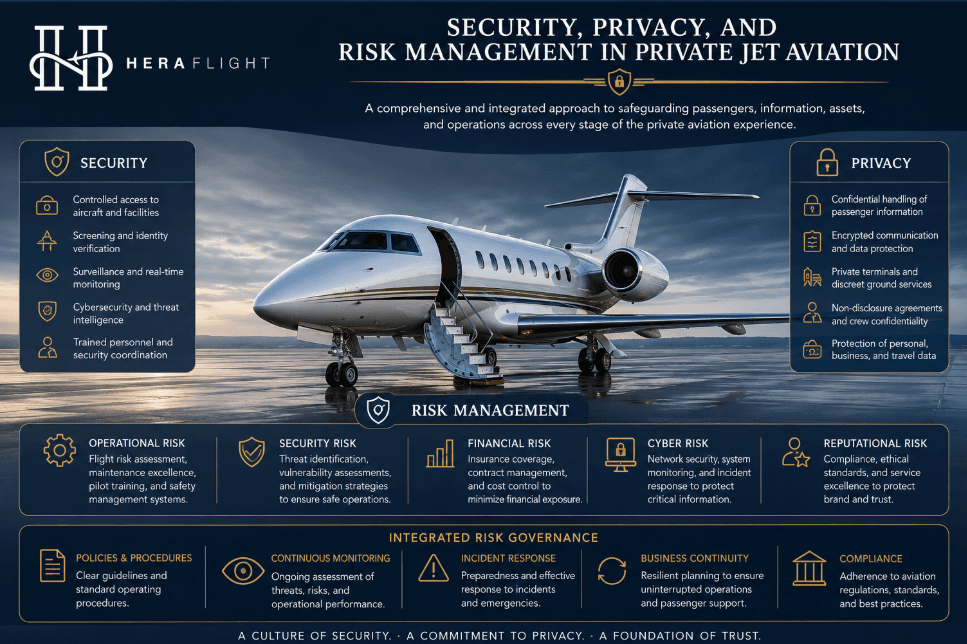
As international mobility becomes increasingly interconnected, private aviation operators face rising pressure to protect passengers, aircraft, operational data, and logistical infrastructure within highly visible global destinations. Major financial centers, luxury tourism regions, international events, and politically sensitive environments now require sophisticated security coordination that balances operational efficiency with heightened privacy expectations.
High-net-worth individuals, corporate executives, diplomats, celebrities, and family offices frequently travel to destinations that attract intense media attention, dense public activity, geopolitical sensitivity, or concentrated luxury tourism. In these environments, private aviation serves not only as a transportation solution, but also as a strategic risk-management mechanism designed to reduce exposure, preserve confidentiality, and maintain operational control.
Modern private aviation increasingly operates at the intersection of mobility, security infrastructure, intelligence coordination, and digital risk management. Providers such as Hera Flight Charter reflect the growing industry emphasis on flexible, discreet international mobility, supported by highly coordinated operational planning.
What Defines a High-Visibility Destination?
High-visibility destinations are locations that attract heightened political attention, media coverage, luxury tourism, financial activity, or international event traffic.
Examples include:
These cities frequently host:
As a result, they often experience heightened security sensitivity and operational complexity.
Why Visibility Increases Operational Risk
Concentrated public attention may increase several categories of aviation-related risk, including:
Private aviation clients often prioritize discretion specifically to reduce these forms of exposure.
Operational planning within these environments, therefore, requires significantly enhanced coordination and situational awareness.
The Demand for Discreet Transportation
For many private aviation clients, privacy is a primary motivation for avoiding commercial airlines.
High-profile travelers frequently seek protection from:
Private aviation reduces these vulnerabilities by providing:
This level of operational discretion is particularly important in destinations with high media visibility or celebrity concentration.
Airport Infrastructure and Privacy Management
Executive airports and fixed-base operators (FBOs) play a critical role in supporting passenger privacy.
Unlike commercial terminals, private aviation facilities often provide:
Airports such as Farnborough, Teterboro, and Le Bourget have built strong reputations around discreet executive mobility and secure passenger handling.
Passenger Protection Strategies
High-profile travelers may require enhanced physical security coordination during international travel.
Private aviation operators frequently work alongside:
to ensure safe and uninterrupted mobility.
Security planning may include:
This integrated approach helps minimize operational vulnerability throughout the travel process.
Risk Assessment Before Departure
Modern aviation security increasingly relies upon proactive risk analysis rather than reactive operational response.
Before international flights, operational teams may evaluate:
This intelligence-based planning improves operational resilience while reducing exposure to unforeseen disruptions.
The Expansion of Aviation Cyber Threats
As aviation operations become increasingly digitalized, cybersecurity has emerged as a major strategic concern.
Private aviation systems now depend heavily upon interconnected digital infrastructure involving:
These systems may become targets for cyber intrusion, data theft, or operational disruption.
Protecting Passenger Data and Operational Information
High-net-worth travelers frequently require strict confidentiality regarding:
Operators therefore invest heavily in encrypted communication systems, secure booking platforms, and controlled information-sharing procedures.
Maintaining confidentiality has become a central component of premium aviation service delivery.
Aviation During Major Global Events
Large-scale international events significantly increase operational complexity for private aviation providers.
Events such as:
Often, they create temporary environments involving elevated congestion, increased media activity, restricted airspace, and heightened security monitoring.
During these periods, aviation operators must coordinate:
Operational flexibility becomes essential within these rapidly changing environments.
Managing Crowded Infrastructure Systems
High-visibility destinations frequently experience temporary infrastructure saturation during peak events.
Challenges may include:
Private aviation operators, therefore, rely heavily upon predictive planning and regional airport diversification strategies.
Protecting High-Value Aviation Assets
Private aircraft themselves represent valuable strategic assets requiring extensive security oversight.
Security procedures may involve:
At international destinations, operators must also coordinate with local airport authorities to maintain aircraft security standards across multiple jurisdictions.
Crew Vetting and Operational Integrity
Flight crews play a central role in aviation security culture.
Operators frequently implement:
A strong operational culture significantly contributes to risk reduction across global aviation systems.
AI-Assisted Operational Security
Artificial intelligence increasingly supports aviation risk analysis by helping operators identify emerging vulnerabilities and operational disruptions.
Modern systems may analyze:
This predictive capability improves operational decision-making within dynamic international environments.
Real-Time Operational Monitoring
Advanced digital platforms now allow operators to maintain continuous situational awareness throughout international travel operations.
Capabilities may include:
These technologies enhance both security responsiveness and operational efficiency.
Maintaining Luxury Service Standards
Although security procedures are increasingly sophisticated, private aviation clients continue to expect seamless and comfortable travel experiences.
Operators must therefore balance:
The most effective aviation systems integrate security discreetly into broader service environments without disrupting passenger comfort.
Trust as a Competitive Advantage
Within private aviation, trust remains one of the industry’s most valuable operational assets.
Clients increasingly select providers based upon:
A strong risk-management infrastructure therefore, directly contributes to long-term client retention and brand credibility.
Increasing Complexity of International Mobility
As geopolitical uncertainty, digital threats, and international mobility continue evolving, aviation security systems will likely become increasingly integrated and intelligence-driven.
Future developments may include:
These technologies are expected to improve operational resilience across global aviation networks.
Smarter and More Adaptive Aviation Ecosystems
Future aviation security models will likely focus on creating highly adaptive systems that respond rapidly to changing operational conditions without compromising efficiency or passenger experience.
In this environment, successful private aviation operators will increasingly combine operational flexibility, digital intelligence, and proactive security coordination into fully integrated global mobility ecosystems.
Why is security especially important in private aviation?
Private aviation frequently serves high-profile individuals, executives, diplomats, and affluent travelers who require enhanced privacy, operational discretion, and risk management during international travel.
What are high-visibility aviation destinations?
High-visibility destinations are locations associated with major international events, luxury tourism, financial activity, media attention, or diplomatic importance.
How does private aviation improve passenger privacy?
Private aviation provides dedicated terminals, restricted-access facilities, confidential scheduling, direct tarmac boarding, and personalized passenger handling procedures.
What types of risks do aviation operators manage?
Operators manage physical security risks, cybersecurity threats, operational disruptions, airport congestion, regulatory challenges, and passenger confidentiality concerns.
Why is cybersecurity important in aviation?
Modern aviation systems rely heavily on digital infrastructure involving scheduling, communication, maintenance, and passenger data management, making cybersecurity increasingly critical.
How do operators prepare for major international events?
Operators use predictive planning, airport coordination, security assessments, slot management, and real-time operational monitoring to manage elevated demand and security complexity.
What role does technology play in aviation security?
AI systems, predictive analytics, biometric verification, and real-time tracking platforms help operators improve risk analysis, operational coordination, and threat response capability.