



Charter Flights

Empty Leg Flights
Available Fleet
Blog
Contacts


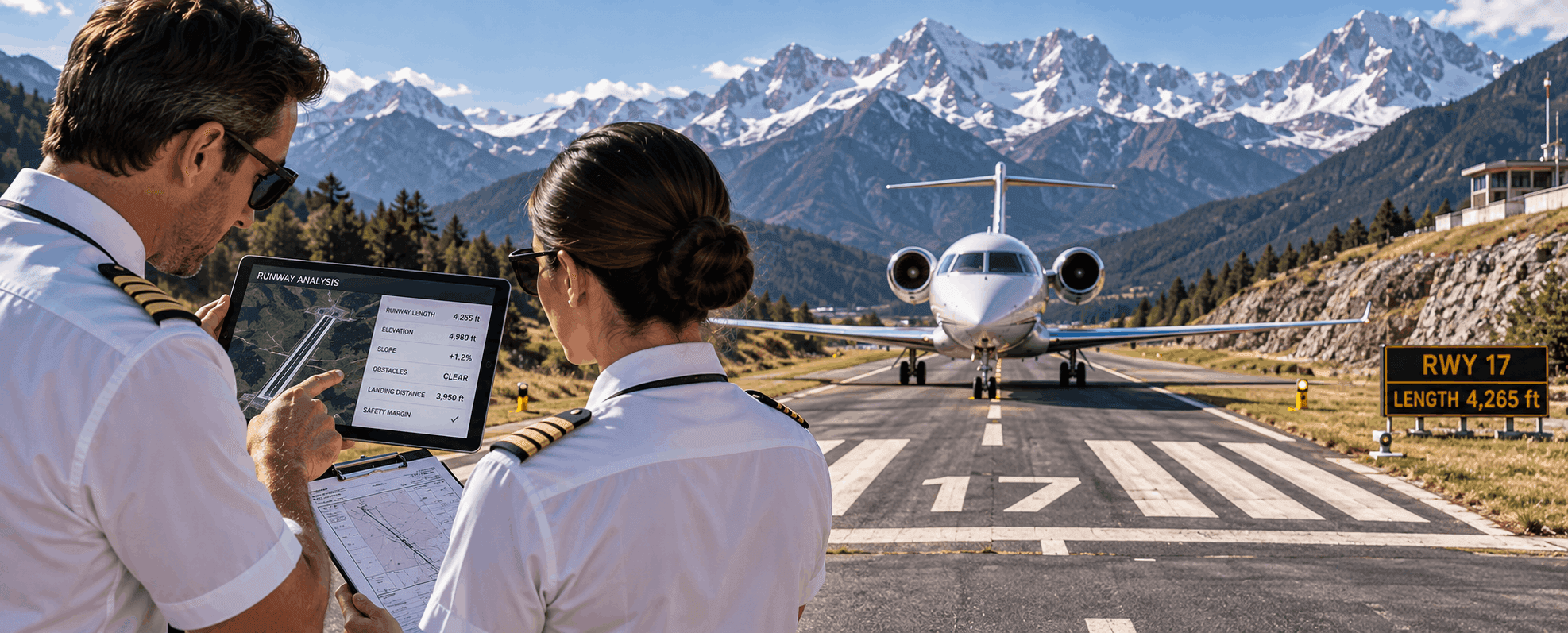
One of the major advantages of private aviation is access to airports that commercial airlines may not serve. Smaller regional airports, executive terminals, and remote airfields can bring travelers much closer to their final destination.
However, not every private jet can operate safely from every runway. Runway length is only one part of the equation. Pilots and operations teams must also consider aircraft weight, temperature, elevation, runway condition, wind, surrounding terrain, and the performance characteristics of the specific aircraft.
Every aircraft requires a certain amount of runway for takeoff and landing. The exact distance depends on the aircraft model, its weight, environmental conditions, and airport characteristics.
A light jet may be able to operate comfortably from a relatively short runway, while a larger or heavier aircraft may require significantly more distance. Pilots do not simply compare the published runway length with a single number from the aircraft manual. They calculate performance for the actual conditions expected on that day.
A heavier aircraft generally needs more runway. Before departure, the crew considers the weight of the aircraft itself, passengers, baggage, fuel, catering, and any additional equipment onboard.
A jet carrying only a few passengers and limited fuel may be able to use an airport that would be unsuitable if the same aircraft were fully loaded for a long-range mission. This is why aircraft range and runway performance are closely connected.
Hot weather can reduce aircraft performance. As temperature increases, air density decreases, which can reduce engine and aerodynamic performance and increase the runway distance required for takeoff.
A private jet that can operate comfortably from a runway on a cool morning may face more restrictive limits during a hot afternoon. In some cases, an earlier departure can improve performance margins.
High-elevation airports present similar challenges. The thinner air at higher elevations reduces aircraft performance, particularly during takeoff and climb.
When high elevation is combined with high temperature, the effect can become even more significant. Pilots account for density altitude when evaluating performance.
A dry runway generally provides better performance than one that is wet, snow-covered, icy, or otherwise contaminated. Water, snow, or ice can increase stopping distance during landing and may affect acceleration during takeoff.
Operators use performance data appropriate to the expected runway condition rather than assuming ideal circumstances. This can sometimes make a runway temporarily unsuitable even when the aircraft normally operates there.
A headwind generally helps by reducing the aircraft’s ground speed for a given airspeed. A tailwind has the opposite effect and may increase the runway distance required.
Crosswinds also matter because every aircraft has operational limits and practical considerations for takeoff and landing in strong crosswind conditions.
Pilots must think beyond the physical end of the runway. After takeoff, the aircraft needs to climb safely while maintaining appropriate clearance from terrain and obstacles.
An aircraft may technically be able to leave the ground within the available runway but still face performance limitations because it cannot meet required climb criteria after takeoff at a particular weight. This is why some mountain airports can be more restrictive than their runway length alone would suggest.
An aircraft must be able to land safely as well as take off. Landing calculations consider aircraft weight, runway length, runway condition, wind, temperature, elevation, and braking performance.
A runway that is adequate for takeoff may not necessarily provide the same margin for landing under certain conditions. Pilots therefore evaluate both phases independently.
If a short runway limits the maximum allowable takeoff weight, the aircraft may not be able to depart with enough fuel for a long nonstop mission.
One solution is to load less fuel, depart at a lower weight, and make a planned fuel stop at an airport with a longer runway or more favorable conditions. A fuel stop in this situation is not necessarily a range problem. It may be a runway-performance solution.
A larger group or heavy baggage can affect whether an aircraft can use a short runway. Golf clubs, skis, equipment cases, and multiple large suitcases can all increase total weight.
This is why operators ask for accurate passenger and baggage information before departure, especially when operating from performance-sensitive airports.
Some aircraft are optimized for short-field performance and can operate from airports with relatively limited runway length. Others are designed primarily for long-range efficiency and larger cabin capacity.
A larger aircraft is therefore not automatically the better choice. For a trip involving a short runway, a smaller jet with strong takeoff and landing performance may be more suitable than a larger aircraft with greater range.
If the preferred airport is too restrictive, the operator may recommend a nearby airport with a longer runway. Although this can add some ground transportation time, it may allow the use of a more suitable aircraft or avoid payload restrictions.
Private aviation remains flexible because travelers are often able to choose among several airports in the same region.
Aircraft compatibility with an airport cannot be determined by runway length alone. Pilots consider aircraft weight, fuel load, passenger and baggage requirements, temperature, elevation, wind, runway condition, and surrounding terrain.
When a crew recommends a different jet, a reduced fuel load, an earlier departure, or a nearby airport, the decision is based on performance planning designed to keep the flight both efficient and safely within the aircraft’s operating capabilities.