



Charter Flights

Empty Leg Flights
Available Fleet
Blog
Contacts


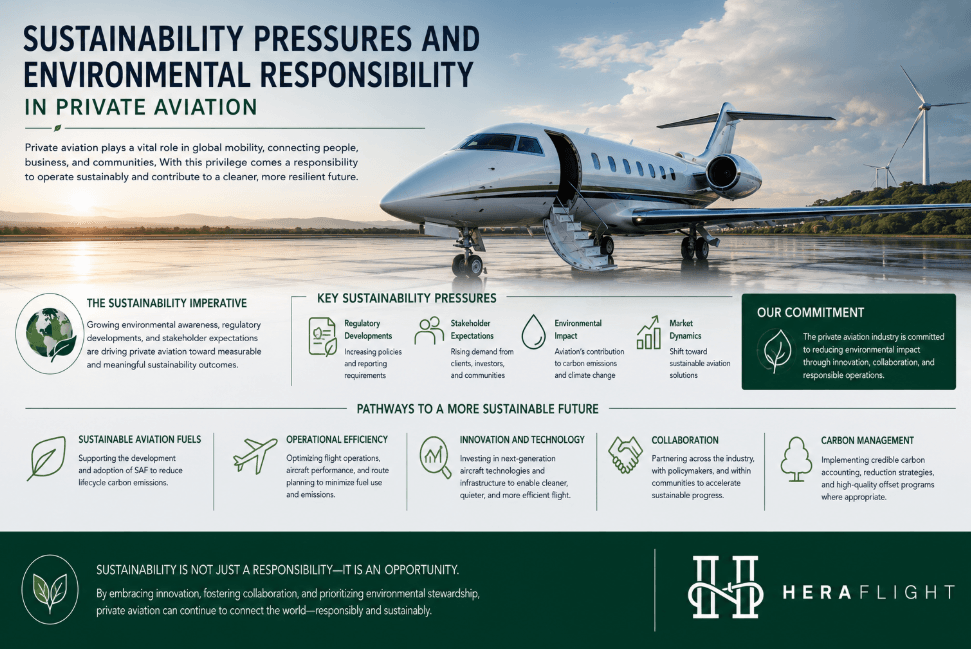
Private aviation is undergoing a significant transformation as environmental sustainability becomes an increasingly influential factor in global transportation policy, corporate governance, and consumer expectations. Historically associated primarily with flexibility, exclusivity, and operational convenience, private aviation now faces growing scrutiny regarding emissions intensity, fuel consumption, and long-term environmental impact.
As climate concerns continue influencing international regulation and investment priorities, aviation operators are under increasing pressure to demonstrate measurable environmental responsibility while maintaining the flexibility and service standards expected within premium mobility markets. Governments, regulatory agencies, investors, and environmentally conscious travelers increasingly expect the aviation sector to align with broader decarbonization objectives and long-term sustainability frameworks.
The aviation industry has publicly committed to achieving net-zero carbon emissions by 2050, with Sustainable Aviation Fuel (SAF) widely recognized as one of the sector’s most important decarbonization tools. However, achieving meaningful environmental progress within private aviation remains operationally and economically complex.
Modern operators increasingly combine fleet modernization, fuel optimization, carbon reduction programs, digital operational intelligence, and sustainability-oriented aircraft management strategies to balance operational performance with environmental accountability. Services such as Hera Flight Aircraft Management reflect the growing importance of efficient fleet oversight and long-term operational sustainability within evolving global aviation markets.
Private aviation has become a highly visible topic within broader climate discussions because of the industry’s emissions profile relative to passenger volume.
Research indicates that emissions from private jets increased substantially between 2019 and 2023 as demand for business aviation expanded globally.
Critics frequently argue that private aviation represents a disproportionately carbon-intensive mode of transportation. At the same time, industry participants emphasize that business aviation serves operationally essential roles involving:
The debate increasingly centers not on whether aviation emissions exist, but on how rapidly and effectively the sector can transition toward lower-emission operational models.
Environmental, Social, and Governance (ESG) frameworks now strongly influence aviation-related investment and corporate travel decisions.
Institutional investors, multinational corporations, and family offices increasingly evaluate:
within aviation partnerships and mobility planning.
As a result, sustainability has become both a regulatory issue and a competitive business consideration within private aviation.
Sustainable Aviation Fuel (SAF) refers to renewable or waste-derived aviation fuel designed to reduce lifecycle carbon emissions compared to conventional fossil-based jet fuel.
According to the International Civil Aviation Organization (ICAO), SAF currently represents the aviation industry’s most significant opportunity for large-scale emissions reduction.
SAF may be produced from:
Depending on production method, SAF can reduce lifecycle emissions by up to 80% relative to traditional jet fuel.
Despite its environmental potential, SAF adoption remains operationally constrained.
Industry analysts note several key limitations, including:
Recent industry data suggests SAF still represents less than 1% of total global jet fuel demand.
These limitations make large-scale implementation difficult despite strong public commitments from airlines and aviation operators.
Governments increasingly support SAF expansion through:
The European Union’s ReFuelEU Aviation regulation and similar North American policy initiatives are expected to accelerate SAF production growth over the coming decade.
Fleet modernization represents one of the most immediate methods for improving environmental performance within private aviation.
Modern aircraft increasingly incorporate:
These innovations reduce both fuel consumption and operational emissions.
New-generation aircraft may also improve:
Fleet renewal therefore plays a central role in long-term aviation sustainability strategy.
Modern aircraft often provide environmental advantages alongside economic benefits.
Operators may achieve:
As fuel costs and environmental pressures continue increasing, older aircraft fleets may become progressively less competitive within international markets.
Operational efficiency has become increasingly important within aviation sustainability planning.
Modern flight optimization systems analyze:
to reduce unnecessary fuel burn and emissions exposure.
Reducing holding patterns, taxiing inefficiency, and empty repositioning flights may significantly improve operational sustainability.
One of private aviation’s environmental challenges involves repositioning flights conducted without passengers.
These so-called “empty leg” operations increase emissions intensity because aircraft operate without productive passenger utilization.
Operators increasingly seek to minimize these inefficiencies through:
Digital platforms now play an increasingly important role in reducing operational waste.
Many private aviation providers now offer carbon offset programs designed to compensate for flight-related emissions through environmental investment initiatives.
Offset programs may support:
Although offsetting remains controversial among some environmental analysts, it continues functioning as an important transitional mechanism within current aviation sustainability frameworks.
Travelers and institutional clients increasingly expect measurable sustainability reporting from aviation operators.
Environmental accountability may include:
Transparent reporting is becoming increasingly important for maintaining credibility within environmentally conscious markets.
Aircraft management services play a major role in improving sustainability performance across private aviation fleets.
Professional management systems help optimize:
Centralized oversight may significantly reduce operational inefficiencies across complex aviation networks.
Sustainability increasingly influences long-term aircraft ownership decisions.
Operators now evaluate:
Integrated management systems therefore help owners align operational performance with evolving environmental standards.
Platforms such as Hera Flight Aircraft Management demonstrate how modern fleet oversight increasingly combines operational efficiency, aircraft optimization, and sustainability-oriented planning.
Artificial intelligence increasingly supports sustainability optimization within aviation operations.
AI-driven systems may improve:
These technologies reduce operational waste while improving scheduling precision.
Beyond SAF, aviation researchers continue exploring alternative propulsion systems involving:
Hydrogen technologies in particular show long-term potential for reducing aviation emissions significantly, although major infrastructure challenges remain.
While these technologies remain in early stages, they may substantially reshape future aviation sustainability strategies.
Affluent travelers increasingly evaluate aviation providers according to sustainability performance alongside traditional service factors such as privacy, flexibility, and comfort.
Modern clients may prioritize:
This shift reflects broader changes within luxury consumption patterns where environmental responsibility increasingly influences purchasing behavior.
Operators capable of integrating sustainability into broader operational strategy may gain long-term competitive advantages within evolving global mobility markets.
Environmental leadership increasingly contributes to:
Sustainability therefore functions not only as regulatory compliance, but also as strategic market positioning.
Private aviation faces growing sustainability pressure as governments, investors, corporations, and travelers increasingly demand measurable environmental responsibility from the global transportation sector. Emissions reduction, operational efficiency, sustainable fuel adoption, and transparent reporting are becoming central priorities across modern aviation systems.
While significant challenges remain involving SAF availability, infrastructure limitations, and long-term technology development, the industry is gradually moving toward more sustainable operational models through fleet modernization, digital optimization, carbon reduction initiatives, and smarter aircraft management systems.
Future progress will likely depend upon continued investment in sustainable fuel production, advanced aircraft technology, AI-assisted operational efficiency, and integrated environmental strategy across the broader aviation ecosystem.
As global mobility continues evolving, the long-term success of private aviation may increasingly depend upon its ability to balance operational flexibility and luxury service with meaningful environmental accountability.