



Charter Flights

Empty Leg Flights
Available Fleet
Blog
Contacts


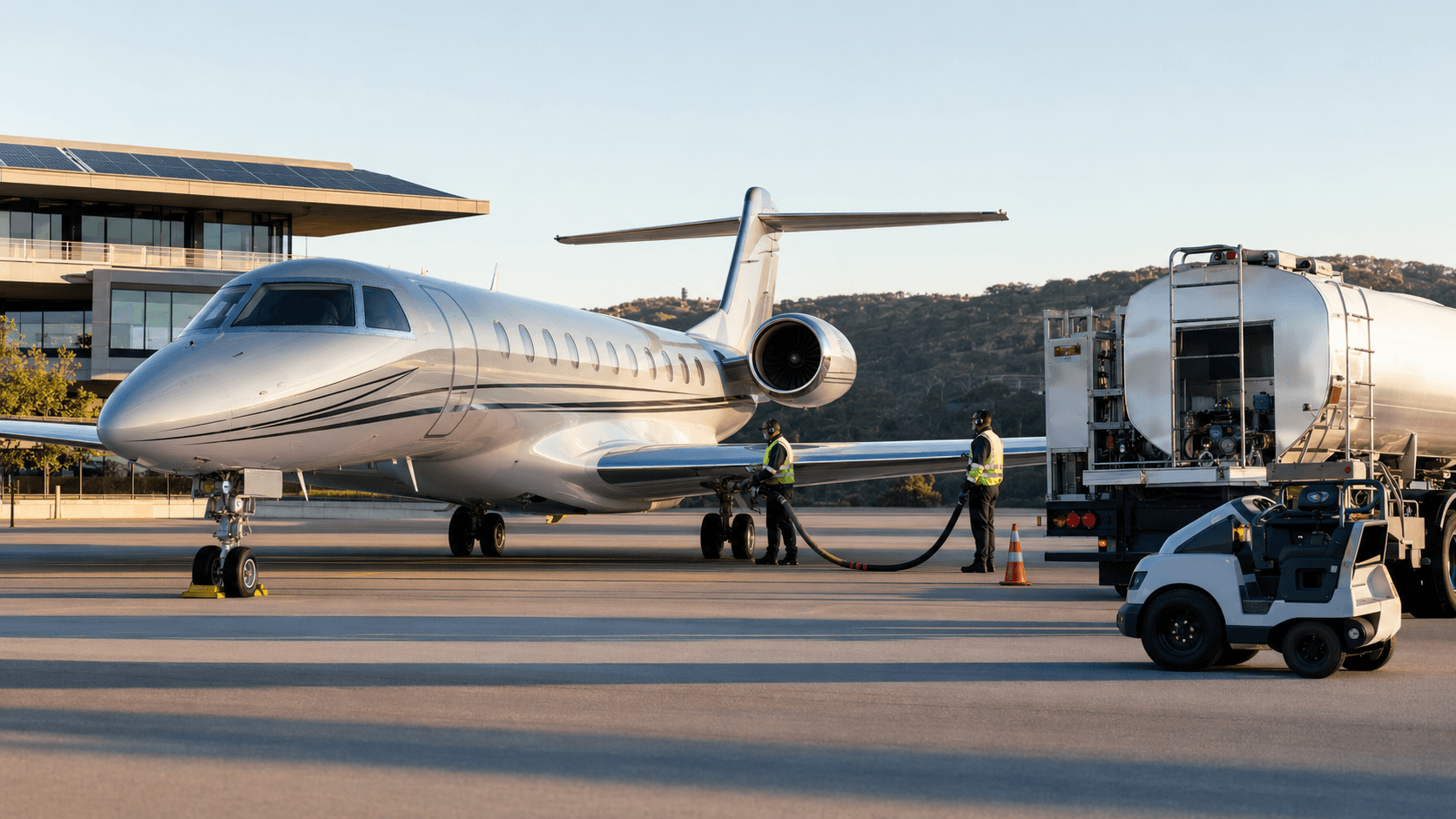
The aviation industry is undergoing one of the most significant transformations in its history. As global attention increasingly focuses on climate change, environmental responsibility, and sustainable economic development, aviation stakeholders face growing pressure to reduce carbon emissions while preserving the connectivity, efficiency, and mobility that modern air transportation provides.
Within this evolving landscape, Sustainable Aviation Fuel (SAF) has emerged as one of the most promising solutions for reducing aviation's environmental impact. Unlike many future technologies that remain in developmental stages, SAF is available today and can be integrated into existing aviation operations without requiring fundamental changes to aircraft design or airport infrastructure.
For business aviation, SAF represents a particularly important opportunity. The sector has long been recognized for its ability to adopt innovative technologies, pioneer operational improvements, and serve as a testing ground for advancements that later influence broader aviation markets. As sustainability becomes an increasingly important consideration for operators, corporations, family offices, and private travelers, SAF is expected to play a central role in shaping the future of responsible private aviation.
Understanding the significance of Sustainable Aviation Fuel requires examining not only how it works but also how it aligns with the operational realities and strategic objectives of modern business aviation.
Sustainable Aviation Fuel refers to aviation fuel produced from renewable or sustainable feedstocks rather than conventional fossil-based petroleum sources.
These feedstocks may include:
The objective is to create aviation fuel that performs similarly to conventional jet fuel while significantly reducing lifecycle greenhouse gas emissions.
Importantly, SAF is not a completely different fuel in operational terms. Certified SAF blends are designed to meet rigorous aviation standards and can generally be used within existing aircraft engines and fuel systems.
This compatibility has made SAF one of the most practical pathways toward aviation decarbonization.
Business aviation occupies a unique position within the broader aviation ecosystem.
The sector supports:
At the same time, business aviation faces increasing scrutiny regarding environmental performance.
As corporate sustainability commitments become more ambitious and environmental, social, and governance (ESG) considerations influence organizational decision-making, private aviation stakeholders are seeking ways to reduce emissions without compromising operational flexibility.
For many operators and clients, SAF offers an immediate and actionable solution.
One of the most important advantages of Sustainable Aviation Fuel is its ability to reduce lifecycle carbon emissions.
Unlike conventional jet fuel, which introduces carbon that has been stored underground for millions of years, SAF is derived from renewable sources that participate in shorter carbon cycles.
Depending on production pathways and feedstock sources, SAF can significantly reduce lifecycle greenhouse gas emissions compared to traditional jet fuel.
The exact reduction varies according to:
However, SAF is widely recognized as one of the most effective tools currently available for reducing aviation-related emissions.
Many aviation organizations have established long-term commitments to achieving net-zero carbon emissions.
SAF is expected to contribute substantially toward these goals because it enables emissions reductions within existing operational frameworks.
Unlike future technologies that may require decades to mature, SAF can deliver environmental benefits immediately.
One of the primary reasons SAF has gained widespread support is its operational compatibility.
SAF is commonly described as a "drop-in" fuel because it can be blended with conventional jet fuel and used within existing aircraft fleets.
This compatibility offers significant advantages.
Current business aircraft generally do not require major modifications to utilize approved SAF blends.
This allows operators to adopt SAF without making substantial investments in new equipment.
Airport fueling systems, storage facilities, and operational procedures can typically accommodate SAF with minimal adjustments.
This reduces implementation barriers and accelerates adoption.
Because SAF integrates with current aviation systems, operators can begin incorporating it into their sustainability strategies today rather than waiting for future technologies to become commercially viable.
Historically, business aviation has often served as an incubator for innovation.
The sector has been among the first to embrace:
A similar pattern is emerging with SAF adoption.
Many business aviation operators, manufacturers, and corporate flight departments have demonstrated strong commitments to increasing SAF utilization.
Several leading aircraft manufacturers now conduct delivery flights using SAF and actively encourage operators to incorporate sustainable fuel into routine operations.
This leadership role may help accelerate broader industry adoption.
Environmental responsibility has become a central component of corporate governance.
Organizations increasingly evaluate business decisions through the lens of ESG performance, including travel policies and transportation choices.
Business aviation users frequently incorporate SAF into broader sustainability strategies designed to support:
By utilizing SAF, organizations can demonstrate measurable progress toward environmental objectives while preserving the operational advantages of private aviation.
For many corporations, this balance is becoming increasingly important.
Despite its considerable potential, SAF adoption faces several challenges.
Global SAF production remains relatively small compared to overall aviation fuel demand.
Expanding production capacity will require substantial investment in:
Until production increases significantly, availability may remain constrained.
SAF currently costs more than conventional jet fuel.
Although prices are expected to improve as production scales, cost remains an important consideration for many operators and travelers.
SAF availability varies considerably by location.
While some major aviation hubs have established SAF supply networks, many airports still lack regular access to sustainable fuel options.
Expanding geographic availability represents a critical objective for the aviation industry.
Aircraft manufacturers are playing an increasingly active role in promoting SAF adoption.
Leading business aviation companies are investing in:
Manufacturers recognize that sustainable fuel will remain an essential component of aviation's environmental strategy for decades to come.
Several have publicly committed to ensuring that future aircraft are capable of operating with increasingly higher SAF blend ratios as regulatory approvals evolve.
Luxury travel is evolving.
Historically, luxury was often associated solely with comfort, exclusivity, and personalized service. Today's affluent travelers increasingly expect premium experiences to align with their environmental values.
As a result, sustainability is becoming an important component of luxury travel.
Private aviation providers that integrate SAF into their operations can offer clients:
The future of luxury aviation is likely to combine exceptional service with meaningful environmental responsibility.
Governments and industry organizations increasingly recognize SAF as a critical tool for aviation decarbonization.
Many jurisdictions are implementing policies designed to encourage SAF production and utilization through:
At the same time, industry groups continue fostering collaboration among:
This collaborative approach is essential for accelerating SAF adoption and achieving long-term sustainability objectives.
Over the coming decades, SAF is expected to become increasingly integrated into business aviation operations.
Future developments may include:
Although SAF alone will not eliminate aviation emissions, it is likely to remain one of the most important pillars of aviation's sustainability strategy.
Combined with advances in aircraft design, operational efficiency, and emerging propulsion technologies, SAF will contribute significantly to the industry's long-term environmental transformation.
While SAF represents a critical tool, true sustainability requires a comprehensive approach.
Business aviation organizations increasingly pursue broader environmental initiatives such as:
SAF functions most effectively when integrated within a broader sustainability framework.
This holistic perspective is becoming increasingly common among leading aviation stakeholders.
Sustainable Aviation Fuel represents one of the most practical and impactful solutions currently available for reducing aviation's environmental footprint. By offering substantial lifecycle emissions reductions while maintaining compatibility with existing aircraft and infrastructure, SAF provides an immediate pathway toward more sustainable business aviation operations.
Although challenges related to production capacity, cost, and availability remain, industry momentum continues to build. Operators, manufacturers, governments, and travelers increasingly recognize that SAF will play a central role in achieving long-term sustainability objectives.
At Hera Flight, we believe the future of private aviation depends upon balancing operational excellence with environmental responsibility. Sustainable Aviation Fuel offers a meaningful opportunity to advance both goals simultaneously, enabling travelers to enjoy the flexibility, efficiency, and comfort of private aviation while contributing to a more sustainable future for the industry.
As business aviation continues to evolve, SAF will remain a cornerstone of the sector's commitment to innovation, responsible growth, and sustainable global mobility.