



Charter Flights

Empty Leg Flights
Available Fleet
Blog
Contacts


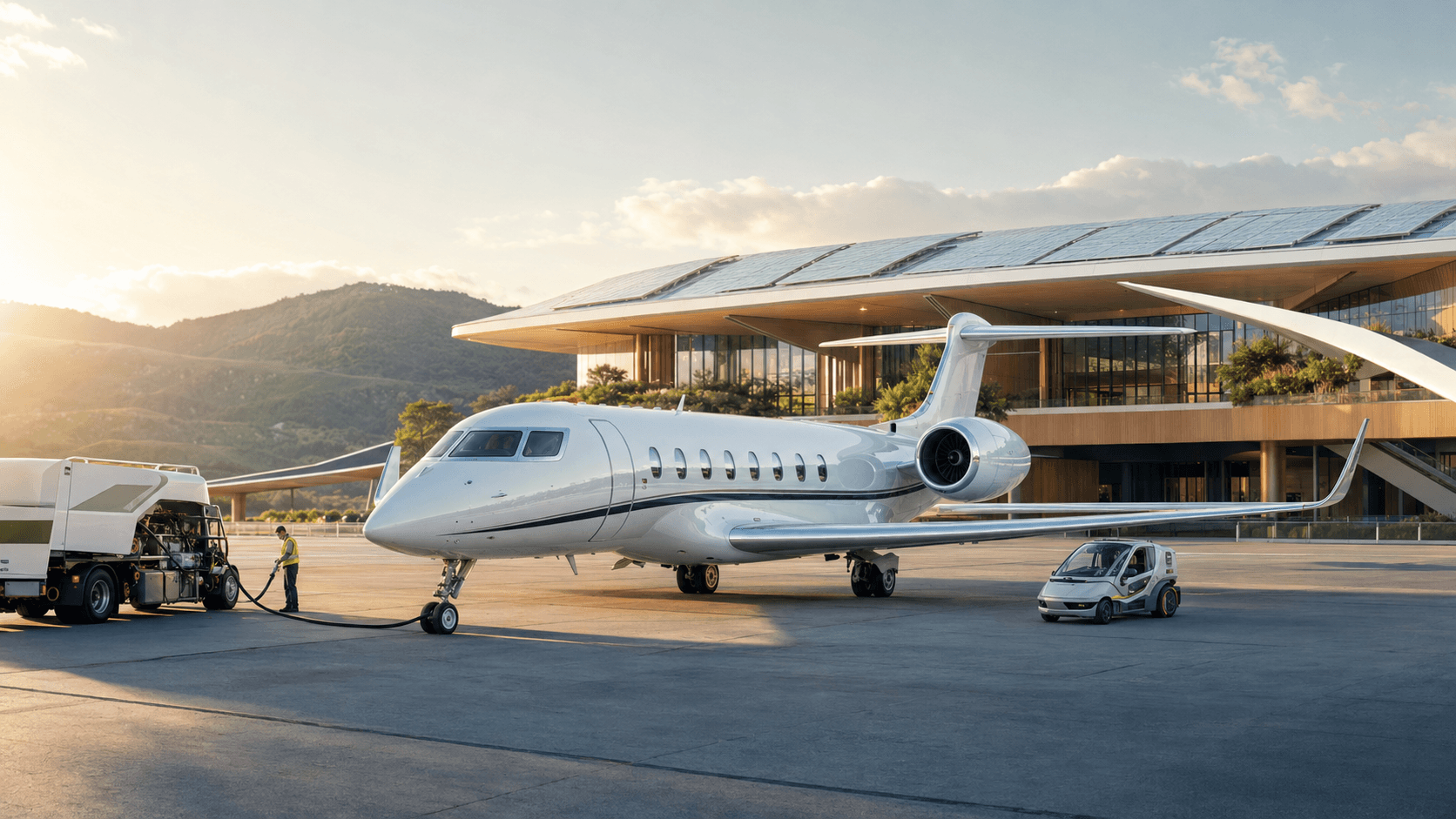
Sustainability has emerged as one of the most significant challenges and opportunities facing the global aviation industry. As governments, corporations, investors, and consumers place increasing emphasis on environmental responsibility, aviation stakeholders are under growing pressure to reduce carbon emissions while maintaining the connectivity and economic benefits that air travel provides.
Within this broader transformation, private aviation occupies a unique position. Although business aviation accounts for a relatively small percentage of global aviation activity, it has increasingly become a focal point in discussions regarding environmental impact, technological innovation, and the future of sustainable mobility. As a result, aircraft manufacturers, operators, fuel providers, regulators, and travelers are actively exploring solutions designed to improve environmental performance without compromising safety, efficiency, or operational flexibility.
The future of sustainable private aviation will not be defined by a single breakthrough technology. Rather, it will emerge through a combination of innovations involving fuel production, aircraft design, operational efficiency, digital technologies, and evolving traveler expectations. Together, these developments have the potential to reshape the industry while preserving the unique advantages that make private aviation an essential component of global transportation.
Aviation plays a critical role in supporting economic development, international trade, tourism, and global connectivity. However, aircraft operations also contribute to greenhouse gas emissions, making sustainability a strategic priority across the sector.
The challenge is particularly complex because aviation requires energy-dense fuel sources capable of supporting long-distance travel, high performance, and strict safety requirements. Unlike many ground transportation systems, aviation cannot easily transition to existing renewable energy solutions without significant technological advancements.
For private aviation, the challenge involves balancing environmental responsibility with the operational capabilities that clients depend upon, including:
The industry's response increasingly focuses on reducing emissions while maintaining these core advantages.
Among all sustainability initiatives currently available, Sustainable Aviation Fuel (SAF) is widely regarded as the most practical near-term pathway toward reducing aviation emissions.
SAF is produced from renewable and non-petroleum feedstocks, including:
Unlike alternative propulsion systems that require entirely new aircraft architectures, SAF can often be used within existing aircraft and airport infrastructure.
One of the primary advantages of SAF is its potential to reduce lifecycle carbon emissions significantly compared to conventional jet fuel.
Although exact reductions vary depending on production methods and feedstock sources, SAF can substantially lower overall greenhouse gas emissions while maintaining operational compatibility with current aircraft fleets.
For private aviation operators seeking immediate sustainability improvements, SAF represents the most viable solution currently available.
Despite its promise, SAF faces several challenges:
Increasing production and improving distribution networks will be critical to expanding SAF adoption across the private aviation sector.
Aircraft manufacturers are investing heavily in technologies designed to improve fuel efficiency and reduce environmental impact.
Modern business jets already demonstrate substantial improvements compared to earlier generations through advances in:
Future aircraft are expected to deliver even greater gains.
Improved wing designs reduce drag and optimize fuel consumption throughout the flight envelope.
Manufacturers are increasingly utilizing computational fluid dynamics and advanced engineering techniques to create highly efficient aircraft structures.
Modern aircraft incorporate extensive use of carbon-fiber composites and other lightweight materials that reduce structural weight without compromising strength or safety.
Lower aircraft weight translates directly into reduced fuel consumption and improved operational efficiency.
Engine manufacturers continue developing propulsion systems that offer:
These advancements contribute significantly to sustainability objectives while maintaining aircraft performance.
Hybrid-electric propulsion has emerged as a promising area of research within the broader aviation industry.
Although current battery technologies are not yet capable of supporting long-range business aviation missions, hybrid systems may eventually offer advantages for certain aircraft categories.
Potential benefits include:
Short-range and regional aircraft are likely to serve as early testing grounds for hybrid-electric technologies before wider adoption becomes feasible.
While large-scale implementation remains years away, hybrid propulsion represents an important component of the industry's long-term sustainability strategy.
Hydrogen is increasingly attracting attention as a potential future aviation fuel.
When utilized effectively, hydrogen can generate energy with minimal direct carbon emissions, making it an attractive option for long-term decarbonization efforts.
However, significant technical challenges remain, including:
Consequently, hydrogen-powered business aviation is unlikely to become commercially widespread in the immediate future.
Nevertheless, ongoing research suggests that hydrogen may eventually play a meaningful role in sustainable aviation ecosystems.
Technological innovation alone will not achieve sustainability objectives.
Operational improvements also offer significant opportunities to reduce environmental impact.
Private aviation operators increasingly utilize advanced systems designed to optimize:
These improvements can generate measurable reductions in fuel consumption and emissions while enhancing operational performance.
Modern flight planning software enables operators to identify more efficient routes while accounting for:
Even modest efficiency improvements across thousands of flights can produce meaningful environmental benefits.
Digital transformation is becoming an increasingly important component of sustainability strategies.
Advanced analytics, artificial intelligence, and predictive technologies allow operators to improve resource utilization and reduce waste.
Examples include:
By identifying maintenance requirements before issues develop, predictive systems can improve aircraft efficiency and reduce unnecessary operational disruptions.
Data-driven scheduling enables operators to maximize aircraft utilization while minimizing empty repositioning flights.
Continuous monitoring allows operators to identify opportunities for incremental efficiency improvements.
These technologies contribute to both environmental and operational objectives.
While long-term technological solutions continue to develop, many private aviation organizations utilize carbon offset programs as part of broader sustainability initiatives.
Carbon offset programs typically support projects involving:
Although offsetting is not a substitute for direct emissions reduction, it can contribute to comprehensive environmental strategies when combined with other sustainability measures.
Many corporate aviation users now integrate carbon offset programs into their broader environmental, social, and governance (ESG) commitments.
One of the most significant changes occurring within private aviation is the growing alignment between luxury and sustainability.
Historically, environmental responsibility and luxury were often viewed as competing concepts. Today, many travelers increasingly expect premium service providers to demonstrate meaningful commitments to sustainability.
This shift reflects broader changes in consumer attitudes, particularly among younger generations of business leaders and wealth creators.
Future luxury aviation experiences are likely to be defined not only by comfort and exclusivity but also by environmental stewardship and responsible mobility.
Achieving meaningful sustainability progress requires collaboration across the aviation ecosystem.
Key stakeholders include:
Collective action will be essential for accelerating technological development, expanding SAF availability, and establishing supportive regulatory frameworks.
The future of sustainable aviation depends upon coordinated efforts rather than isolated initiatives.
Despite substantial progress, important challenges remain.
These include:
Addressing these obstacles will require continued innovation, investment, and cooperation across the aviation industry.
However, the industry's commitment to sustainability continues to strengthen as environmental considerations become increasingly central to long-term strategic planning.
By 2040, sustainable private aviation may incorporate:
Passengers may increasingly evaluate aviation providers based on both service quality and environmental performance.
Sustainability could become a defining characteristic of competitive differentiation within the premium travel sector.
The future of sustainable private aviation will be shaped by a combination of technological innovation, operational efficiency, environmental responsibility, and evolving traveler expectations. While no single solution will eliminate aviation emissions entirely, the industry is making meaningful progress through Sustainable Aviation Fuel adoption, next-generation aircraft development, advanced operational practices, and long-term investments in alternative propulsion technologies.
Private aviation has historically been associated with flexibility, efficiency, and exceptional service. In the coming decades, sustainability is likely to become an equally important component of the industry's value proposition.
At Hera Flight, we recognize that the future of aviation depends on balancing global mobility with environmental stewardship. By supporting innovation, embracing responsible practices, and helping clients make informed travel decisions, we remain committed to contributing to a more sustainable future for private aviation.
The path toward sustainability will require collaboration, investment, and continuous improvement. Yet the industry's ongoing transformation demonstrates that environmental responsibility and exceptional aviation experiences can evolve together, shaping a future where luxury, performance, and sustainability are no longer competing priorities but complementary objectives.