



Charter Flights

Empty Leg Flights
Available Fleet
Blog
Contacts


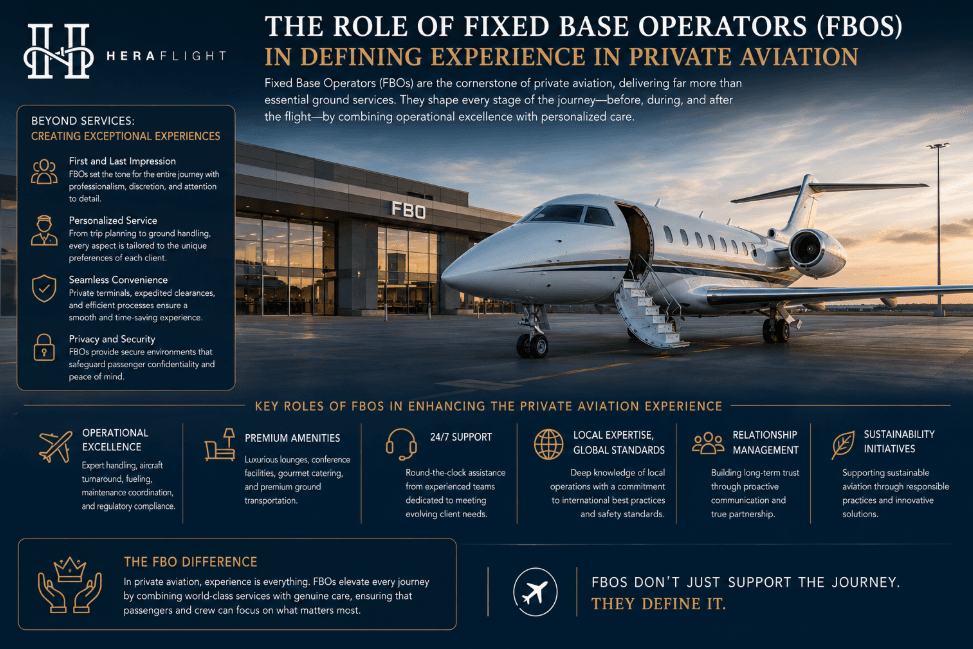
Within private aviation, passenger experience is shaped by far more than aircraft performance or cabin luxury alone. One of the most influential — yet often overlooked — components of executive aviation is the Fixed Base Operator (FBO). These facilities function as the operational and hospitality foundation of private aviation, directly influencing convenience, privacy, efficiency, security, and overall traveler perception.
Unlike commercial airport terminals designed to process large passenger volumes, FBOs are highly specialized aviation environments tailored specifically for private aircraft operations and executive mobility. They serve as dedicated terminals where passengers, crews, and aircraft operators receive personalized services designed to minimize friction and maximize operational flexibility.
As private aviation increasingly evolves into a broader luxury mobility ecosystem, FBOs have become central to defining how passengers experience international travel. In many cases, the quality of an FBO shapes customers' perceptions of the entire journey before they even board the aircraft.
Modern executive aviation, therefore, depends heavily upon FBO infrastructure capable of combining operational precision with hospitality-oriented service delivery.
Defining the FBO
A Fixed Base Operator is a private aviation service provider operating at an airport and offering support services for business jets, charter aircraft, crews, and passengers.
Typical FBO services include:
FBOs operate as dedicated private aviation terminals separate from standard commercial airport systems.
The Origins of the FBO Concept
The term “Fixed Base Operator” originated in the early development of civil aviation in the United States. It referred to aviation businesses operating from fixed airport locations that provided fueling, maintenance, and operational services for aircraft owners.
Over time, the role of FBOs expanded significantly as business aviation evolved into a global luxury mobility industry.
Today’s premium FBOs increasingly resemble private hospitality environments rather than conventional transportation facilities.
Reducing Airport Stress
One of the primary advantages of FBOs is the elimination of many stress factors associated with commercial air travel.
Passengers using FBO facilities typically avoid:
Instead, travelers experience streamlined processing, personalized service, and significantly greater environmental control.
This reduction in cognitive stress plays a major role in shaping passenger satisfaction and emotional comfort.
Privacy as a Premium Value
Privacy represents one of the defining characteristics of private aviation, and FBOs are central to maintaining this exclusivity.
FBO environments often provide:
For executives, celebrities, diplomats, and high-net-worth individuals, this level of discretion is often essential.
Passengers increasingly evaluate private aviation providers according to how effectively privacy is preserved throughout the entire travel process.
Faster Processing and Departure Coordination
FBOs significantly improve operational efficiency compared to traditional commercial airport systems.
Private aviation passengers may often arrive only minutes before departure because FBO operations minimize unnecessary procedural delays.
Operational advantages include:
These efficiencies are particularly important for business travelers operating within highly time-sensitive environments.
Supporting Dynamic Scheduling Flexibility
Unlike commercial aviation, private aviation schedules frequently change in response to evolving business needs, weather conditions, or passenger requirements.
FBOs support this flexibility through:
This responsiveness allows operators to maintain scheduling agility across complex international mobility networks.
FBOs as Luxury Environments
Modern premium FBOs increasingly resemble luxury hospitality spaces rather than transportation terminals.
Many facilities now incorporate:
These environments reinforce the broader perception of private aviation as a seamless lifestyle experience rather than simply a transportation service.
Personalized Passenger Service
FBOs frequently provide highly individualized support tailored to passenger preferences.
Services may include:
The ability to anticipate and personalize service expectations has become a major differentiator within competitive private aviation markets.
Controlled Access Environments
Security remains one of the most important operational priorities within private aviation.
FBOs contribute to risk reduction through:
These procedures improve passenger safety while preserving confidentiality and operational integrity.
Supporting High-Profile Travelers
Many FBOs regularly accommodate:
As a result, facilities increasingly integrate advanced security coordination involving:
The role of FBOs within executive risk management continues to expand globally.
Supporting Airport Ecosystems
FBOs contribute significantly to airport revenue generation and regional economic activity.
Their operations support:
In many regions, private aviation activity generates substantial secondary economic benefits across the hospitality, real estate, and financial services sectors.
Strategic Importance in Business Aviation
Airports with robust FBO infrastructure often attract more executive aviation activity because operators prioritize efficiency, reliability, and service quality.
Highly regarded FBO networks may influence:
As private aviation expands globally, premium FBO infrastructure increasingly functions as a strategic competitive asset.
Digital Coordination Systems
Modern FBOs increasingly rely on digital platforms to improve operational coordination and passenger convenience.
Technology integration may include:
These systems improve responsiveness while reducing operational inefficiency.
AI and Predictive Passenger Services
Artificial intelligence is increasingly supporting personalized service delivery in private aviation environments.
Advanced systems may analyze:
This predictive capability allows FBOs to deliver increasingly individualized customer experiences.
Environmental Responsibility at Executive Airports
As sustainability expectations rise across aviation, FBOs are increasingly adopting environmentally responsible operational practices.
Initiatives may include:
These improvements align FBO operations with broader environmental objectives across the aviation industry.
The Future of Smart Aviation Terminals
Future FBO development will likely emphasize:
The evolution of smart terminal ecosystems may significantly reshape how passengers experience executive aviation in the coming decade.
North American Executive Aviation Culture
North America maintains one of the world’s most extensive FBO networks, reflecting the scale of its private aviation market.
Facilities frequently emphasize:
Large executive airports such as Teterboro and Van Nuys have become internationally recognized private aviation centers.
European and Middle Eastern Approaches
European FBOs often prioritize discretion, elegance, and multilingual coordination within highly regulated operational environments.
Middle Eastern facilities increasingly emphasize:
These regional differences reflect broader cultural approaches to luxury service delivery and executive mobility.
Expanding Beyond Transportation
FBOs are increasingly evolving into integrated mobility environments supporting broader lifestyle and business ecosystems.
Future facilities may integrate:
This transformation reflects the growing convergence between aviation, hospitality, and luxury mobility.
Experience as Competitive Advantage
As private aviation markets become increasingly competitive, passenger experience will likely remain one of the industry’s most important differentiators.
FBOs play a central role in shaping this experience through:
The most successful aviation providers will likely be those capable of integrating these elements into seamless and highly adaptive executive mobility ecosystems.
Fixed Base Operators have become foundational components of modern private aviation, shaping passenger experience through privacy, operational efficiency, personalized hospitality, and advanced security coordination. Far more than simple airport terminals, FBOs function as strategic mobility environments that influence how travelers perceive luxury, comfort, and control throughout the aviation journey.
As international executive mobility continues expanding, FBO infrastructure will likely play an increasingly important role in supporting seamless global travel experiences across diverse markets and operational environments.
Future innovations in sustainability, artificial intelligence, predictive personalization, and integrated digital coordination are expected to further transform how FBOs support both passengers and operators within evolving global aviation ecosystems.