


Charter Flights

Available Fleet

Blog
Contacts


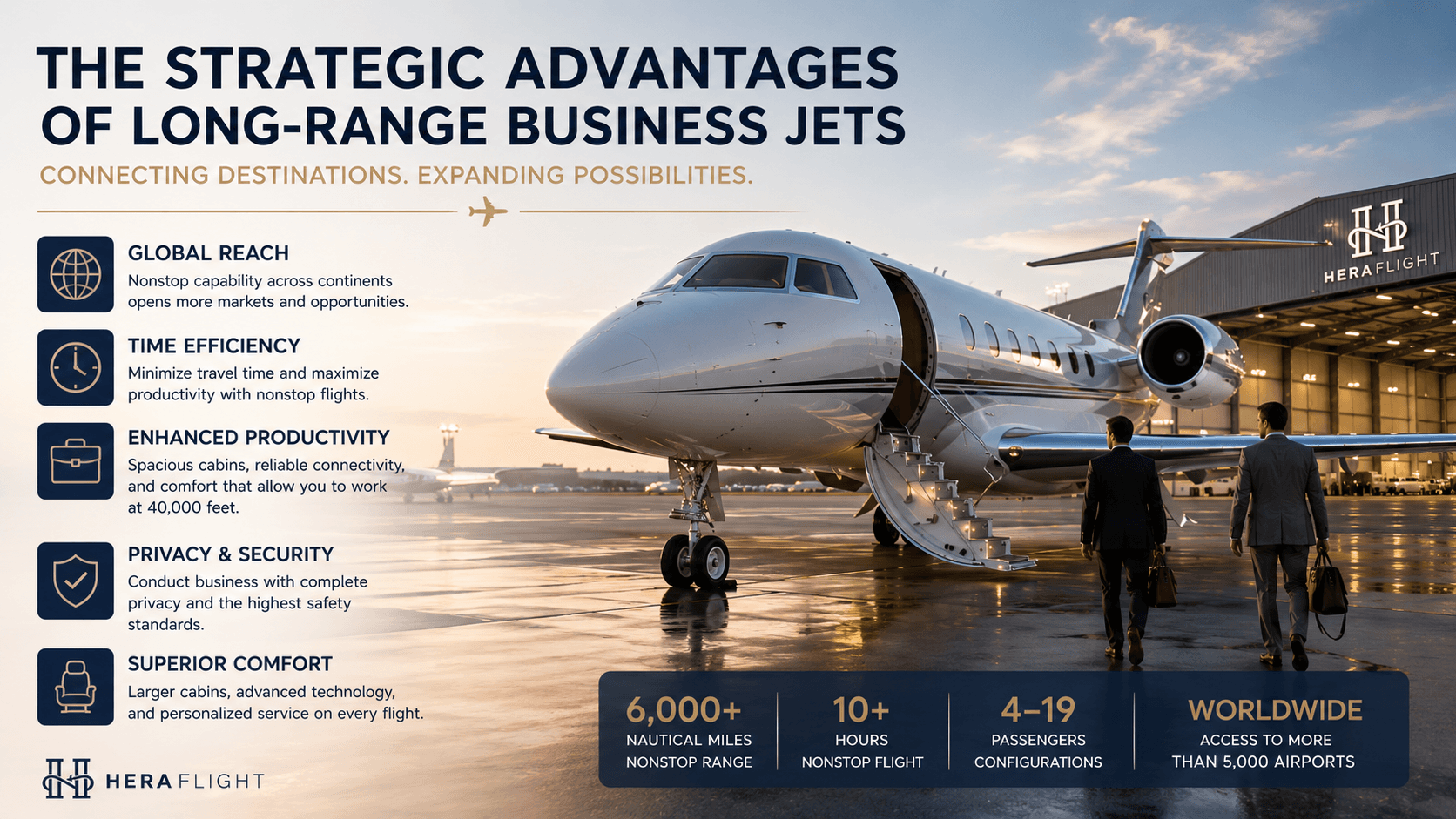
In an increasingly globalized economy, the ability to move executives, investors, government officials, and high-value personnel efficiently across continents is a critical competitive advantage. While commercial aviation continues to serve most international travelers, long-range business jets offer a strategic solution for organizations and individuals whose time, flexibility, and security requirements exceed those of scheduled airline services.
Modern long-range business aircraft can connect major economic centers worldwide without intermediate stops, helping travelers reach destinations more efficiently while maintaining comfort, privacy, and operational control. Beyond luxury, these aircraft are strategic assets that support productivity, international expansion, rapid decision-making, and organizational agility.
As global commerce becomes increasingly interconnected, understanding the strategic value of long-range business aviation is essential for corporations, family offices, entrepreneurs, and government entities seeking to improve mobility and operational performance.
Long-range business jets are aircraft specifically designed for extended missions while maintaining exceptional passenger comfort and operational reliability.
Although classifications vary slightly among manufacturers, long-range and ultra-long-range aircraft generally offer ranges between 4,500 and 8,000 nautical miles or more.
Representative aircraft include:
These aircraft are capable of connecting destinations such as:
without requiring refueling stops under normal operating conditions. This capability leads directly to one of the clearest advantages of long-range business jets: nonstop global connectivity.
Perhaps the most obvious advantage of long-range business jets is their ability to eliminate technical stops and reduce avoidable delays.
Every intermediate landing introduces operational inefficiencies, including:
Nonstop operations streamline travel by reducing overall journey time and minimizing logistical complications.
For multinational organizations operating across multiple regions, direct connectivity significantly improves mobility and enables more effective management of global operations.
Reducing Geographic Barriers
Historically, distance was a significant obstacle to international business development. Today, long-range aircraft effectively compress global geography by enabling direct access to major commercial centers regardless of location.
As a result, organizations can pursue opportunities in emerging markets while maintaining efficient communication and oversight.
Executive time is among the most valuable resources within any organization.
Commercial travel frequently involves:
These inefficiencies can consume substantial amounts of productive time.
Long-range business jets turn travel into a productive environment where executives can continue working throughout the journey.
The Aircraft Cabin as a Mobile Office
Modern long-range aircraft frequently feature:
These capabilities allow decision-makers to conduct meetings, review confidential information, and communicate with global teams while en route. Together, they create a work environment that supports senior executives managing international operations.
For senior executives managing international operations, the productivity gains can be substantial.
One of the defining characteristics of private aviation is flexibility.
Long-range aircraft expand this advantage by allowing organizations to create travel schedules that align with business priorities rather than airline timetables.
Benefits include:
This flexibility can prove particularly valuable during mergers and acquisitions, crisis management situations, site inspections, and international negotiations. As a result, organizations that can mobilize leadership teams rapidly often gain a meaningful competitive advantage.
Organizations that can mobilize leadership teams rapidly often gain a meaningful competitive advantage.
As companies enter new markets, executive travel requirements become increasingly complex.
Commercial airline schedules may not adequately support:
Long-range business jets enable organizations to conduct multiple business activities within compressed timeframes while maintaining efficiency.
Facilitating Global Market Access
Whether evaluating investment opportunities in Asia, overseeing manufacturing operations in Europe, or meeting clients in the Middle East, direct access to international destinations supports more effective strategic decision-making.
Business aviation expands an organization's geographic reach while reducing the logistical challenges of international travel.
Comfort becomes increasingly important as flight duration increases.
Long-haul commercial travel often exposes passengers to:
Long-range business jets are specifically designed to mitigate these challenges. Their cabin environments help explain how they deliver superior passenger comfort on extended flights.
Advanced Cabin Environments
Modern aircraft feature:
These features help reduce fatigue and support passenger well-being during extended journeys.
Dedicated Living Spaces
Many long-range aircraft provide multiple cabin zones that support:
Passengers arrive better rested and ready to perform immediately. This improved arrival experience supports the broader comfort advantages of long-range business jets.
Confidentiality remains a critical consideration for many organizations and individuals.
Commercial travel environments provide limited opportunities for secure discussions, particularly when sensitive information is involved.
Long-range business jets offer controlled environments where passengers can discuss:
Without concern for unauthorized observation or disclosure.
For publicly traded companies, private equity firms, and government agencies, this level of confidentiality can be particularly valuable. It also reinforces the security advantages that follow.
Security considerations extend beyond confidentiality.
Business aviation gives organizations greater control over travel environments, reducing exposure to risks associated with crowded transportation hubs.
Advantages include:
For executives, high-profile individuals, and government officials, these measures contribute significantly to overall risk management strategies. This security control adds another layer of value to long-range business aviation.
Long-range aircraft are increasingly utilized by family offices and private individuals whose activities span multiple continents.
These travelers often require:
The ability to travel directly between residences, business interests, and vacation properties provides exceptional convenience and efficiency.
Certain industries derive particular value from long-range business aviation.
Examples include:
Private Equity and Investment Management
Investment opportunities often require rapid evaluation and immediate decision-making. Direct access to international markets enhances responsiveness and due diligence capabilities.
Energy and Natural Resources
Projects frequently operate in remote regions with limited commercial air service. Business aviation improves access to critical infrastructure and operational sites.
Technology and Innovation
Global technology firms often manage teams, partnerships, and facilities across multiple continents. Efficient executive mobility supports collaboration and strategic oversight.
Healthcare and Pharmaceuticals
International clinical trials, research partnerships, and regulatory engagements frequently require rapid global travel.
In each of these sectors, mobility directly influences organizational performance and competitiveness.
Long-range business jets represent substantial investments, whether chartered or owned. However, evaluating these aircraft solely through transportation costs overlooks their broader strategic value.
Potential benefits include:
For organizations whose success depends upon rapid global mobility, the return on investment may extend well beyond traditional cost comparisons.
The next generation of long-range business aircraft will continue to improve operational performance and passenger experience.
Emerging innovations include:
These developments are expected to improve both sustainability and operational efficiency while extending aircraft capabilities.
As international business activity continues to expand, the demand for efficient long-distance transportation is likely to increase.
Long-range business jets are uniquely positioned to address this need by combining:
Organizations that prioritize mobility increasingly view business aviation not as a luxury, but as a strategic infrastructure investment that supports growth, resilience, and competitive advantage.
Long-range business jets have transformed the way organizations and individuals engage with the global economy. By eliminating geographic barriers, enhancing productivity, supporting international expansion, and providing exceptional levels of comfort and security, these aircraft deliver strategic benefits that extend far beyond transportation.
Whether facilitating international negotiations, supporting investment activities, managing global operations, or enabling efficient personal travel, long-range business aviation has become an essential component of modern mobility strategies.
At Hera Flight, we help clients identify the aircraft solutions best suited to their operational objectives, ensuring that every journey maximizes efficiency, flexibility, and value. In an increasingly interconnected world, the strategic advantages of long-range business jets continue to redefine what is possible in global travel.