


Charter Flights

Available Fleet

Blog
Contacts


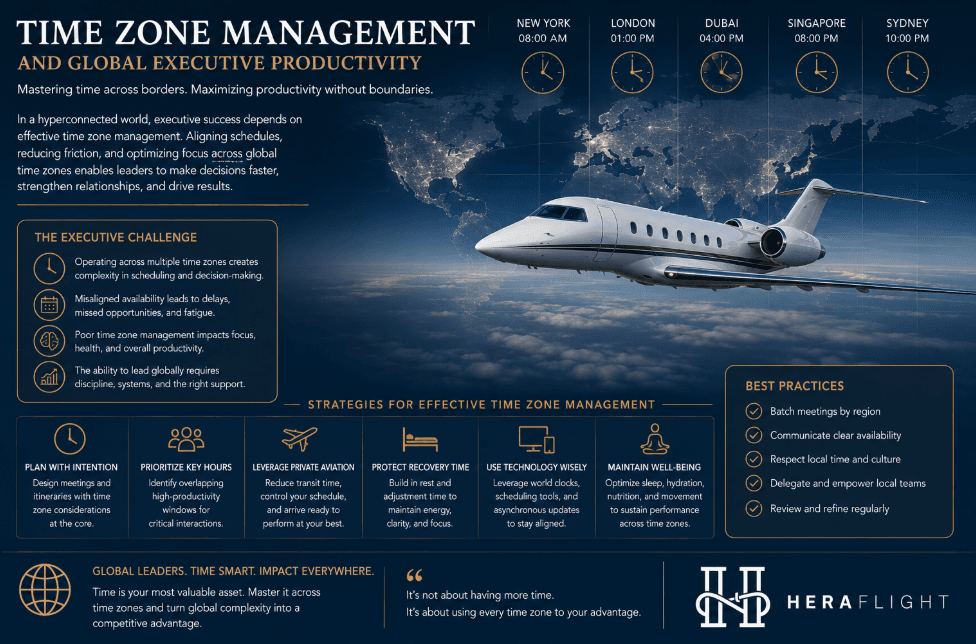
In the modern global economy, executive productivity increasingly depends upon the ability to operate efficiently across multiple time zones, international markets, and continuously interconnected business environments. Senior executives, investors, diplomats, entrepreneurs, and multinational leadership teams now conduct operations simultaneously across North America, Europe, the Middle East, and Asia-Pacific, often within compressed travel schedules and rapidly changing operational conditions.
While digital communication technologies have accelerated international connectivity, physical mobility across global regions continues to create significant physiological and psychological challenges. Crossing time zones affects cognitive performance, decision-making capacity, sleep quality, emotional regulation, and long-term productivity. For globally mobile professionals, managing these disruptions has become a strategic operational priority rather than merely a travel inconvenience.
Private aviation increasingly plays an important role within this environment because it offers scheduling flexibility, reduced travel stress, and greater control over travel conditions compared to commercial airline systems. These advantages help executives better align mobility with productivity demands across international business ecosystems.

As globalization continues intensifying, time zone management is becoming a defining factor in executive performance, operational efficiency, and sustainable international mobility.
Human cognitive and physical performance is heavily influenced by circadian rhythms — internal biological cycles regulating sleep, alertness, hormone production, metabolism, and mental focus.
Rapid travel across time zones disrupts these natural rhythms, often producing symptoms commonly associated with jet lag, including:
For executives operating within high-pressure environments, even moderate circadian disruption may significantly affect strategic performance and professional effectiveness.
Global executives frequently experience intensified exposure to time-zone-related stress because of:
Unlike leisure travelers, executives often move directly from long-haul flights into negotiations, presentations, financial meetings, or operational decision-making environments.
This creates sustained physiological pressure that may accumulate over time.
In international business environments, time functions as one of the most valuable executive resources.
Private aviation supports productivity by reducing several operational inefficiencies associated with commercial travel, including:
This operational flexibility allows executives to preserve greater control over schedules and recovery periods.
Long commercial itineraries often require multiple connections, overnight airport transitions, and unpredictable delays.
Private aviation minimizes these disruptions through:
Reducing logistical friction significantly improves cognitive stability and emotional resilience during international travel.
Global business activity operates according to overlapping regional work cycles involving:
Executives frequently coordinate across several active time zones simultaneously.
Successful international scheduling therefore requires careful alignment between:
Poorly structured travel schedules may substantially reduce performance quality during critical business interactions.
Arrival timing significantly influences executive readiness.
For example:
Private aviation provides greater control over departure and arrival windows, allowing schedules to align more effectively with optimal performance periods.
The onboard environment strongly influences executive recovery during long-haul travel.
Private aviation cabins often provide:
These factors may significantly reduce travel-related stress and improve sleep quality during international flights.
Sleep quality remains one of the most important factors affecting post-flight productivity.
Long-range private aviation increasingly emphasizes:
These features support physiological adaptation across time zones and reduce fatigue-related performance decline.
Research consistently demonstrates that sleep disruption and circadian imbalance affect:
For executives responsible for financial, operational, or diplomatic decisions, these impairments may carry substantial consequences.
Time zone management therefore functions as a performance optimization strategy rather than simply a wellness concern.
Private aviation supports executive cognition by allowing travelers to maintain:
This controlled environment helps minimize the psychological fragmentation commonly associated with complex commercial travel itineraries.
Modern executives increasingly rely on advanced scheduling platforms capable of coordinating international operations across multiple time zones.
These systems may optimize:
Digital planning tools have become essential within globally distributed business environments.
AI-assisted scheduling systems increasingly analyze:
to optimize executive mobility and reduce fatigue exposure.
Predictive systems may eventually help organizations coordinate international travel according to individual physiological performance patterns.
North American business environments often emphasize:
Executives frequently prioritize speed and operational flexibility within international mobility planning.
European business culture often demonstrates greater emphasis on:
This may influence how travel itineraries and recovery periods are managed.
Asia-Pacific business operations frequently require coordination across extremely broad geographic ranges involving:
Executives operating within these markets often experience particularly demanding time-zone complexity.
Corporate leadership increasingly recognizes that sustainable productivity depends upon managing physiological stress and travel fatigue effectively.
Modern mobility strategies increasingly integrate:
These approaches help improve long-term executive performance and reduce burnout risk.
Organizations increasingly evaluate whether travel schedules align with:
As a result, mobility planning is becoming more strategic and data-driven.
Future executive travel systems will likely become increasingly personalized through integration between:
These technologies may help travelers adapt more effectively to international mobility demands.
Private aviation increasingly functions not simply as transportation infrastructure, but as a productivity-support ecosystem designed to preserve executive performance across complex international environments.
The future of global mobility may therefore depend less on speed alone and more on how effectively aviation systems support human cognitive resilience and operational continuity.
Time zone management has become one of the most important operational and physiological challenges within modern global business environments. Executives operating across international markets must continuously balance mobility demands with cognitive performance, recovery quality, and long-term productivity sustainability.
Private aviation supports this process by reducing logistical friction, improving scheduling flexibility, and creating controlled travel environments that minimize fatigue-related disruption. As international business activity continues expanding, effective time-zone management will increasingly influence executive decision-making quality, operational efficiency, and organizational performance.
Future advancements in predictive scheduling, artificial intelligence, wellness-oriented aviation design, and personalized mobility coordination are expected to further reshape how global executives manage international travel and productivity across increasingly interconnected business ecosystems.