



Charter Flights

Empty Leg Flights
Available Fleet
Blog
Contacts


Reliable internet access has become an important part of private aviation, especially for travelers who expect to work, communicate, stream content, or stay connected throughout a flight. Yet Wi-Fi quality can vary significantly from one private jet to another.
Two aircraft with similar cabin sizes and ranges may provide very different connectivity experiences. The reason is that onboard Wi-Fi depends on far more than whether the aircraft has an internet system installed. Satellite technology, antenna design, coverage area, bandwidth, equipment age, network congestion, and the type of service plan all influence performance.
There is no single type of internet system used across private aviation. Different aircraft may use different technologies depending on when the system was installed, where the jet operates, and what level of connectivity the owner or operator wants to provide.
Some systems are designed primarily for email and basic messaging. Others can support video calls, cloud applications, streaming, and multiple connected devices. This is why simply seeing “Wi-Fi available” on an aircraft description does not necessarily tell travelers how fast or capable the connection will be.
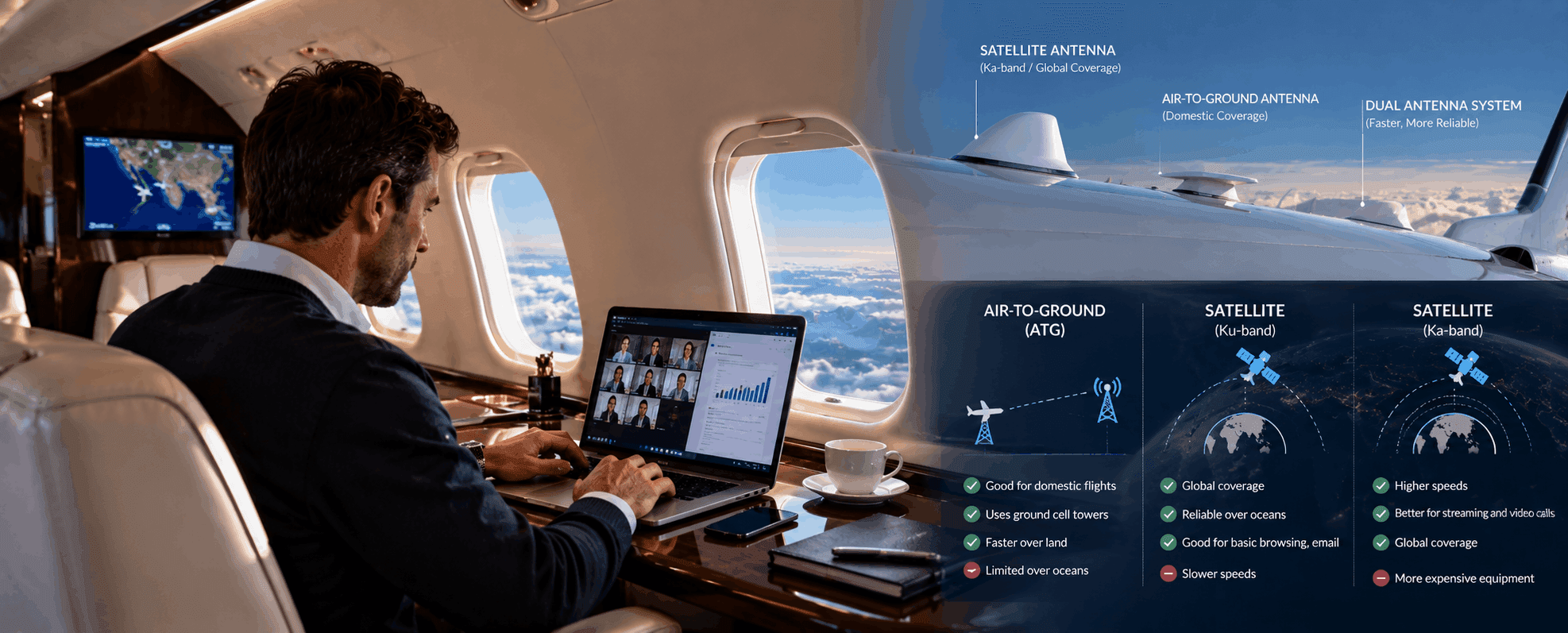
Many private jets rely on satellite-based internet. The aircraft communicates with satellites through an antenna installed on or inside the fuselage. The satellite then connects the aircraft to ground-based network infrastructure.
The quality of the experience depends heavily on the satellite network being used. Newer systems can provide significantly higher data speeds and broader coverage than older generations.
Some networks are designed for global or near-global connectivity, while others may perform best within certain regions. For international travelers, coverage can be just as important as raw speed.
Private aviation connectivity can use different frequency bands, and each has its own strengths. Some systems prioritize broad coverage and reliability, while others are designed to provide higher bandwidth.
Newer high-capacity satellite networks can support much more demanding activities than older systems, including video conferences, large file uploads, and multiple simultaneous devices.
The antenna is a critical part of any airborne internet system. Larger aircraft often have more physical space for higher-capacity antennas and supporting equipment.
Smaller jets may have less available space and tighter aerodynamic or weight constraints. Advances in compact antenna technology are improving options for smaller aircraft, but differences still exist between aircraft categories.
Aircraft age alone does not determine internet quality, but older jets may still use connectivity equipment installed many years ago.
A well-maintained aircraft can remain operationally excellent for decades, while its original Wi-Fi technology becomes outdated much more quickly. An aircraft that received a recent cabin technology upgrade may therefore provide much faster internet than another jet of the same model that still uses an older system.
Even a fast system has a finite amount of available bandwidth. If one passenger is checking email, the connection may feel excellent. If eight passengers are simultaneously streaming video, joining video conferences, uploading large files, and syncing cloud storage, performance may slow.
The number of devices matters as well. One traveler may carry a phone, tablet, and laptop, meaning a cabin with six passengers could easily have a dozen or more connected devices.
The hardware installed on the aircraft is only part of the system. Operators or aircraft owners may also choose different connectivity service plans.
Some plans may provide higher speeds, larger data allowances, or priority access to network capacity. Others may be designed for lighter usage. Two aircraft using similar equipment could therefore offer different real-world performance.
A system that performs well over the continental United States may not provide the same experience over the Atlantic Ocean, remote regions, or certain international destinations.
Satellite networks have different coverage maps. Travelers taking international or long-range flights should therefore consider whether the aircraft’s connectivity system supports the entire route.
Some aircraft connectivity systems can use ground-based networks rather than satellites. These systems communicate with terrestrial antennas while the aircraft is in flight.
They can provide strong performance in regions with extensive ground infrastructure, but their geographic coverage is naturally more limited than satellite-based solutions.
Satellite connectivity is generally designed to operate in a wide range of conditions, but atmospheric conditions can sometimes influence signal quality.
Heavy precipitation or certain weather environments may temporarily reduce performance on some systems. Aircraft orientation, banking, or other operational factors can also affect antenna connection for brief periods.
Messaging and email use relatively little bandwidth. Browsing websites and downloading documents require more. Video conferencing, live streaming, cloud collaboration, and large file transfers can require substantially higher and more consistent performance.
Travelers who need to work intensively in flight should communicate those requirements before booking.
Inside the cabin, routers and wireless access points distribute the connection to passenger devices. Older or poorly positioned cabin equipment can create weak coverage even when the external internet connection is strong.
Larger cabins may require multiple access points to provide consistent service from front to back.
Historically, larger private jets often had an advantage in high-speed connectivity because they had more room for equipment and were frequently used on longer flights. That gap is narrowing.
Newer compact satellite antennas and improved network technology are making higher-speed systems more practical for light and midsize aircraft. Travelers should therefore avoid assuming that a smaller jet automatically has poor Wi-Fi.
If internet access is important to the trip, travelers should ask for more detail than simply whether Wi-Fi is available. Useful questions include what type of system is installed, whether it supports the planned route, and whether activities such as video calls or streaming are practical.
For travelers who consider connectivity essential, Wi-Fi should be treated as part of aircraft selection rather than as a simple yes-or-no amenity. Choosing an aircraft with the right connectivity system can make the difference between merely being online and being genuinely productive throughout the flight.