


Charter Flights

Available Fleet

Blog
Contacts


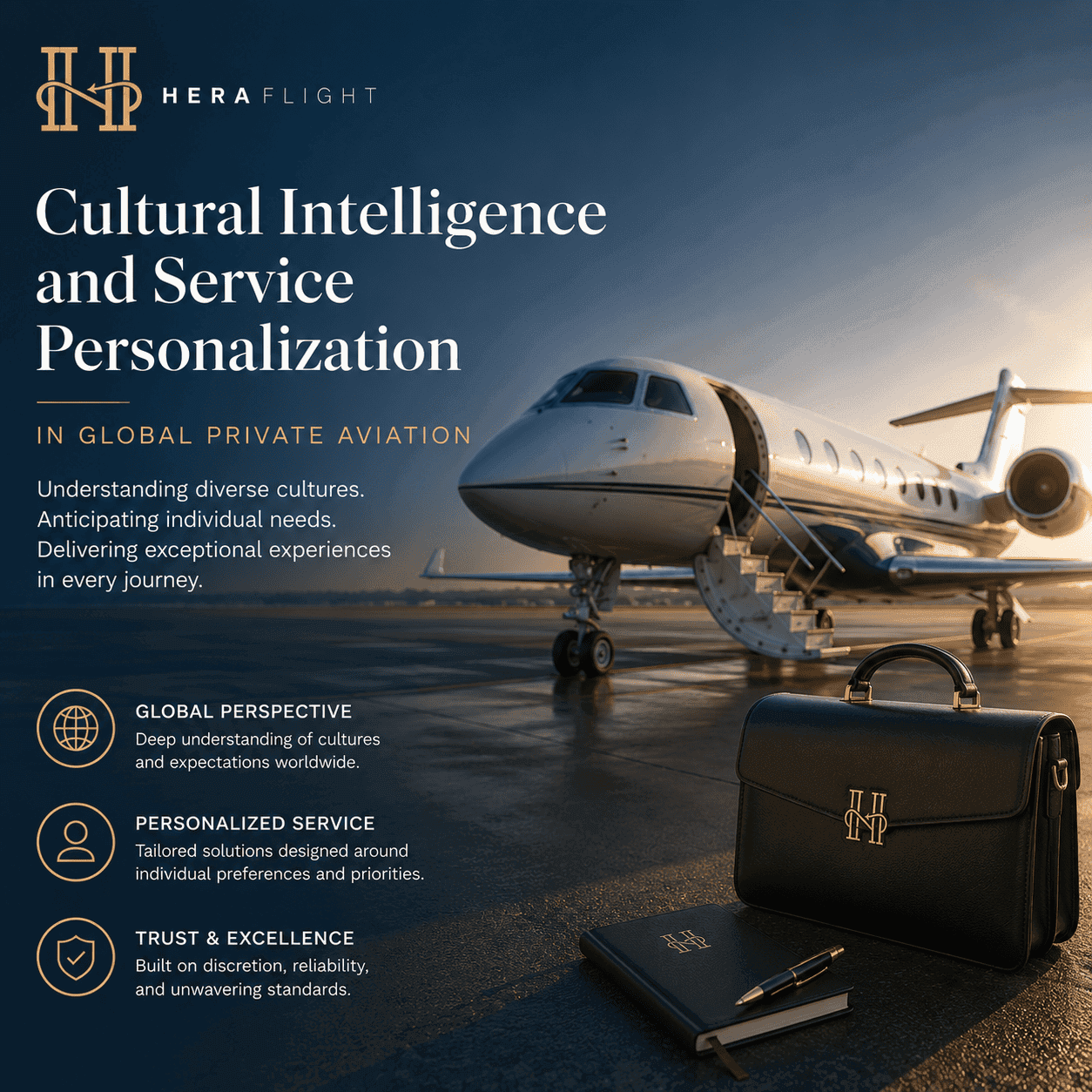
Global aviation has evolved into one of the most internationally interconnected service industries in the modern economy. Private aviation operators, charter providers, airport authorities, and luxury mobility companies now serve clients originating from highly diverse cultural, linguistic, and behavioral backgrounds. As a result, operational success increasingly depends not only on aircraft availability and logistical efficiency, but also on the ability to deliver culturally responsive service experiences across international markets.
In private aviation particularly, where personalization and discretion are central components of the customer experience, cultural intelligence has become a strategic operational asset. High-net-worth travelers frequently expect aviation providers to understand regional hospitality norms, communication preferences, privacy expectations, and relationship dynamics specific to their cultural environments.
Modern luxury aviation therefore operates at the intersection of transportation, hospitality, psychology, and global relationship management. Providers such as Hera Flight increasingly compete within this globalized service landscape by combining operational flexibility with highly personalized customer engagement strategies.
As international mobility continues expanding, the cultural dimensions of service delivery are becoming increasingly important in shaping customer trust, long-term retention, and competitive differentiation across global aviation markets.
Historically, aviation service models emphasized operational standardization. Commercial airlines and early charter operators primarily focused on logistical reliability, safety, and procedural consistency.
However, the expansion of luxury mobility markets has fundamentally transformed passenger expectations. Modern private aviation clients increasingly seek highly individualized experiences that extend beyond transportation itself.
Today’s travelers often expect:
This shift reflects the broader transformation of luxury consumption patterns globally, where experiential quality increasingly outweighs material exclusivity alone.
Private aviation now serves a globally mobile client base that frequently travels between regions with vastly different cultural expectations and communication norms.
Clients from North America, Europe, the Middle East, Asia-Pacific, and Latin America often demonstrate distinct preferences regarding:
Consequently, aviation providers must increasingly adapt service models to accommodate regional behavioral differences while maintaining consistent operational standards.
North American private aviation markets are heavily influenced by corporate productivity culture and time efficiency expectations.
Travelers within the United States and Canada frequently prioritize:
For many North American clients, the primary value of private aviation lies in minimizing inefficiency and preserving productive working time.
As a result, operators serving these markets often emphasize streamlined booking systems, rapid departure capability, and highly responsive communication channels.
North American service culture also tends to favor a balance between professionalism and accessibility. Clients frequently prefer communication styles that are efficient, friendly, and direct without excessive ceremonial formality.
This preference influences how aviation providers structure:
Technology-driven service integration is also particularly important within North American aviation ecosystems.
European private aviation markets frequently demonstrate stronger emphasis on discretion, privacy, and understated sophistication.
In regions such as Switzerland, France, and the United Kingdom, affluent travelers often prioritize:
Luxury within European markets is frequently associated with subtlety rather than overt visibility.
Consequently, service delivery often emphasizes restraint, professionalism, and seamless operational coordination rather than highly visible hospitality displays.
Europe’s geographically interconnected structure creates unique operational service requirements.
Clients frequently move between:
within short timeframes and across multiple regulatory systems.
This environment increases the importance of multilingual communication, customs coordination, and culturally adaptive service teams capable of operating across diverse European business environments.
Hospitality occupies a particularly important role within Middle Eastern luxury culture. As a result, private aviation clients across Gulf markets frequently expect highly personalized and relationship-oriented service experiences.
Service expectations often include:
Within these markets, aviation service frequently functions as an extension of broader hospitality traditions.
Middle Eastern business culture also places strong emphasis on trust, continuity, and long-term relationship development.
Clients often value:
As a result, aviation operators competing within Gulf markets must frequently prioritize relationship-building strategies alongside operational efficiency.
Many Asia-Pacific markets maintain comparatively formal business communication norms influenced by hierarchical organizational structures and cultural emphasis on respect and protocol.
Private aviation clients within the region often prioritize:
Operational discipline and presentation standards may therefore carry particularly strong importance within these environments.
Compared to some Western markets, private aviation demand across parts of Asia-Pacific often demonstrates stronger emphasis on family travel, group mobility, and multi-generational coordination.
Operators increasingly accommodate:
These patterns influence aircraft selection strategies, concierge planning, and onboard service customization.
Many Latin American aviation markets emphasize interpersonal warmth, flexibility, and relationship-driven communication styles.
Clients frequently value:
Human engagement often carries substantial importance within customer relationship management across the region.
Operational unpredictability in some regional infrastructure environments also increases the importance of flexibility within aviation service delivery.
Passengers frequently prioritize providers capable of adapting rapidly to:
Consequently, responsive communication and operational agility become especially valuable competitive assets.
Artificial intelligence and customer analytics increasingly allow aviation providers to anticipate passenger preferences with greater precision.
Modern systems may analyze:
This predictive capability allows operators to deliver increasingly individualized travel experiences across diverse cultural environments.
Despite regional differences, global private aviation clients increasingly expect seamless digital interaction.
Technology-driven services now commonly include:
However, successful operators must balance automation with culturally appropriate human interaction.
In many premium markets, personal relationships remain essential despite technological modernization.
As aviation becomes increasingly globalized, operators invest heavily in cultural intelligence training for flight crews, concierge teams, and customer-facing personnel.
Training programs may address:
These initiatives improve service consistency across internationally diverse passenger environments.
Organizational culture also significantly influences customer experience outcomes.
Aviation companies emphasizing:
are often better positioned to deliver culturally responsive premium services.
Internal alignment between operational standards and customer expectations becomes increasingly important within competitive global aviation markets.
The Future of Cultural Personalization in Aviation
Private aviation is moving toward increasingly integrated and predictive luxury ecosystems where every aspect of the journey may be customized according to passenger preferences.
Future developments may include:
These technologies will likely deepen personalization while improving operational efficiency.
Although luxury mobility standards are becoming increasingly internationalized, regional cultural distinctions will likely remain highly influential.
Successful aviation providers will therefore continue balancing:
Cultural intelligence may increasingly become one of the most important competitive differentiators within premium aviation markets.
The cultural dimensions of service delivery have become central to the evolution of global private aviation. As client bases grow increasingly international and expectations become more personalized, aviation providers must navigate complex intersections between hospitality, communication, operational efficiency, and regional behavioral norms.
North American travelers may prioritize speed and flexibility, European clients often value discretion and precision, Middle Eastern markets emphasize relationship-oriented luxury, and Asia-Pacific passengers frequently expect formal professionalism and continuity of service.
In response, modern aviation operators increasingly integrate cultural intelligence into every aspect of customer engagement, from concierge coordination and crew training to technology systems and operational planning.
As private aviation continues evolving within broader luxury mobility ecosystems, the ability to combine operational excellence with culturally adaptive service delivery will likely define long-term leadership within the global aviation industry.
Cultural intelligence helps aviation providers understand regional communication styles, hospitality expectations, and service preferences, improving customer satisfaction and operational efficiency.
Different regions prioritize different aspects of service. North American clients often value efficiency, Europeans emphasize discretion, Middle Eastern travelers prioritize hospitality, and many Asian markets value formality and consistency.
Personalization allows operators to tailor travel experiences according to passenger preferences involving scheduling, catering, communication style, cabin configuration, and concierge services.
AI systems and customer analytics platforms help operators anticipate passenger preferences, coordinate itineraries, and deliver more seamless travel experiences.
International aviation serves culturally diverse passengers across multiple countries. Multilingual communication improves operational coordination and enhances customer confidence.
Many operators provide cross-cultural hospitality training covering etiquette, communication styles, cultural sensitivity, and international service standards.
Yes. Misaligned communication styles or inappropriate service assumptions may negatively affect passenger satisfaction and brand perception.
The industry is moving toward increasingly integrated luxury ecosystems combining predictive technology, personalized mobility coordination, and culturally adaptive customer engagement.